
Establishing an Autonomous System on the Internet
A personal account of establishing an Autonomous System (AS) on the Internet, detailing the experience, technical specifications, and future plans.
Establishing an Autonomous System on the Internet
Recently, I embarked on a journey to create my own Autonomous System (AS) along with a dedicated IP space. This endeavor serves dual purposes: enhancing my expertise in network technology and exploring potential commercial applications in the future.
Understanding Autonomous Systems
An Autonomous System, or AS, comprises a collection of routers that function as a cohesive entity. These systems communicate with one another using an Exterior Gateway Protocol, with the Border Gateway Protocol (BGP) being the most prevalent globally. Internally, these systems may employ various protocols for routing, including BGP (referred to as iBGP), Routing Information Protocol (RIP), Open Shortest Path First (OSPF), or Intermediate System to Intermediate System Routing Protocol (IS-IS). In my case, I utilize the Babel protocol.
Each AS is identified by a unique international AS number, assigned by the Internet Assigned Numbers Authority (IANA) through five Regional Internet Registries: RIPE NCC, ARIN, APNIC, LACNIC, and AfriNIC. These numbers are standardized as 32-bit values (RFC 6996), while 16-bit numbers (RFC 1930) are still issued under specific circumstances. For internal network use, AS numbers in the ranges of 64512 to 65534 and 4200000000 to 4294967294 are available for assignment.
My Personal Experience
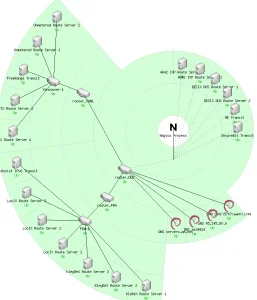
After this extensive introduction, I can summarize my experience succinctly: I applied for an AS through my company, Pankerl – Media, and was assigned AS34924. Currently, this AS hosts three routers connected to six Internet exchange points:
- FRA-1 (Frankfurt, connected to LocIX and KleyReX)
- DUS-1 (Düsseldorf, connected to DE-CIX Düsseldorf and 4b42 Internet Exchange Point in Zurich)
- Vancouver-1 (Vancouver, connected to EVIX Fremont and UNMETERED Exchange Vancouver)
Additionally, I have established several uplinks to facilitate traffic exchange with networks that I cannot directly connect with, such as Telekom (AS3320).
This setup currently supports traffic for one IPv4 network and two IPv6 networks:
- 45.145.80.0/24
- 2602:fed2:770b::/48
- 2a0f:5707:aa00::/44
Future Plans
Looking ahead, I have several initiatives planned:
- Transporting data for Freifunk
- Developing customer solutions, such as Internet connections or BGP integration for clients with their own AS
- Establishing VPN connections for customers to access static IPs
- Collaborating with the forthcoming AS of the Hacker/Makerspace in Schaffenburg to ensure efficient presence at various Internet exchange points without redundancy.
Additional Resources
- Visit the website of my AS hosted on Pankerl – Media's platform.
- Check out the PeeringDB entry, which contains technical details about my AS.