
Hécube, pas Hécube: A Reflection on Justice and Loss
Explore the themes of justice, loss, and the intertwining of reality and performance in Tiago Rodrigues' _Hécube, pas Hécube_.
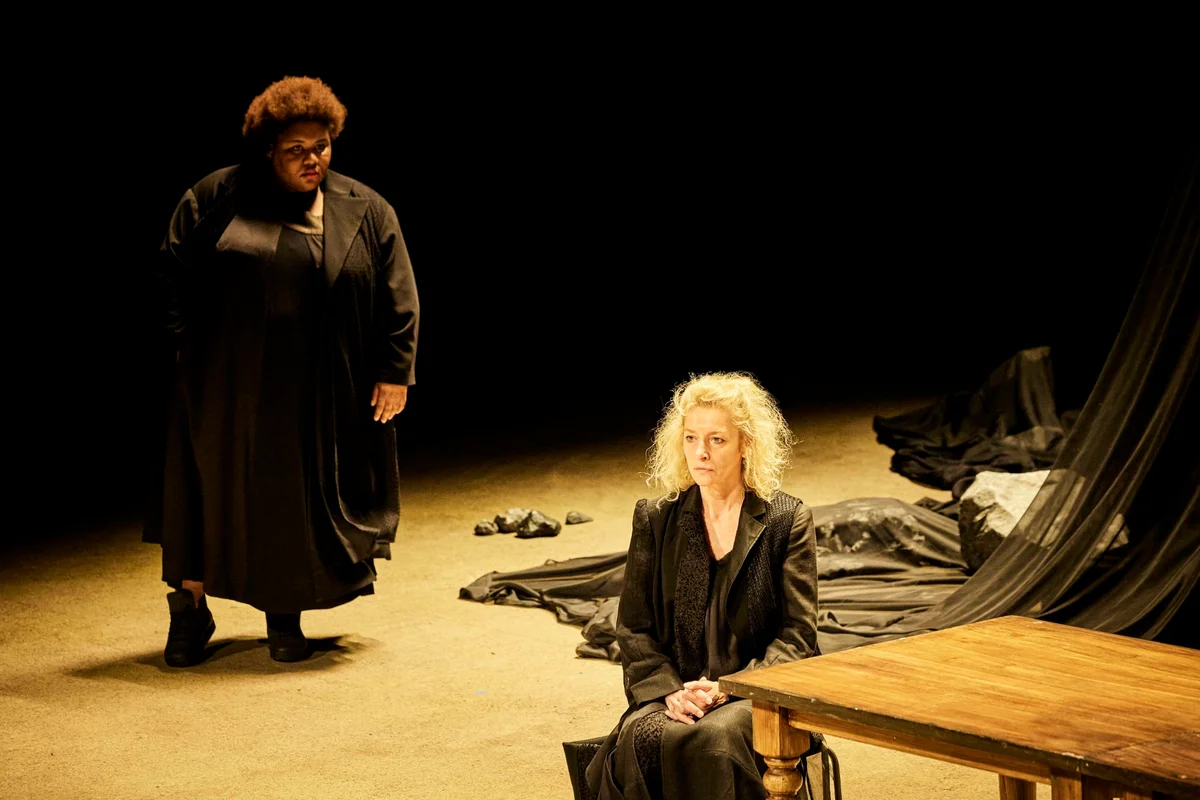
The stage serves not merely as a reflection of reality, but as a unique space of repetition, a site where the act of performing transcends itself: simul et singulis. It becomes a conduit of worlds, akin to an Aleph, where the unformed takes shape and evolves, guided by the prophetic wisdom of the chorus. This is where what is not yet fixed is created, where the future unfolds before the moment of ‘too late’ arrives.
In this narrative, we encounter Nadia, who cries out for justice, and Hécube, who seeks revenge. The tale unfolds through the lens of a fallen queen, stripped of everything and reduced to a state of enslavement. Yet, within the depths of her despair, a performer finds the strength to embody the heroine she portrays, channeling that energy into a personal battle to defend her son.
The stage transforms into both the office of a prosecutor conducting an investigation and the shores of the Aegean Sea, set in the Chersonese of Thrace. It becomes a mirror—both perfect and flawed—reflecting the interplay between these two worlds, where they converge, take on form and meaning, intertwine, or drift apart.
As a site of repetition, the stage also embodies exchange, offering a chance to escape the isolation that afflicts Nadia’s son and, perhaps even more so, Hécube. This character, driven to madness by grief, not only blinds Polymnestor, her son’s murderer, but is also pushed to commit the unthinkable by killing her own children.
Nadia faces scrutiny, compelled to justify herself as women often are, forced to account for the violence inflicted upon her and her son, as if the burden of such suffering rests solely on their shoulders. Meanwhile, Agamemnon is called upon to absolve Hécube’s act of vengeance in the name of justice, a decision likely influenced by his relationship with Cassandra.
The narrative unveils the deceit, hypocrisy, and blindness of powerful men who, even before being rendered blind themselves, refuse to see or acknowledge the truth. They only become aware of their surroundings after losing their sight.
Amidst this turmoil, the warm, enveloping voice of Otis Redding’s music provides a poignant backdrop, underscoring the emotional depth of the performance.
In the end, the theater stands as a dark space where everything is played and replayed, yet nothing is ever the same, a realm more authentic than reality itself.
Hécube, pas Hécube, by Tiago Rodrigues, at the Comédie française
For a sonic illustration, Sittin’ on the dock of the bay, by Otis Redding.