Howlite – The Art of Mindful Slowing Down
In the realm of crystal therapy, howlite is associated with reducing inner noise, fostering balance, and promoting patience. It symbolizes a mindful approach to life, encouraging clarity and emotional integration.
In the realm of crystal therapy, there are stones that are associated with processes of energetic activation, the recovery of inner strength, or the expansion of awareness, while others seem to serve a different, less evident but equally important function. Howlite belongs to this second category, and its work is traditionally linked to the ability to reduce the inner noise that often accompanies daily life, fostering a condition of greater balance between mind, emotions, and perception. In an era characterized by continuous stimuli, increasing speed, and constant demands for attention, this stone symbolically evokes the possibility of slowing down without stopping, observing without reacting immediately, and rediscovering a more stable dimension within one’s experience.
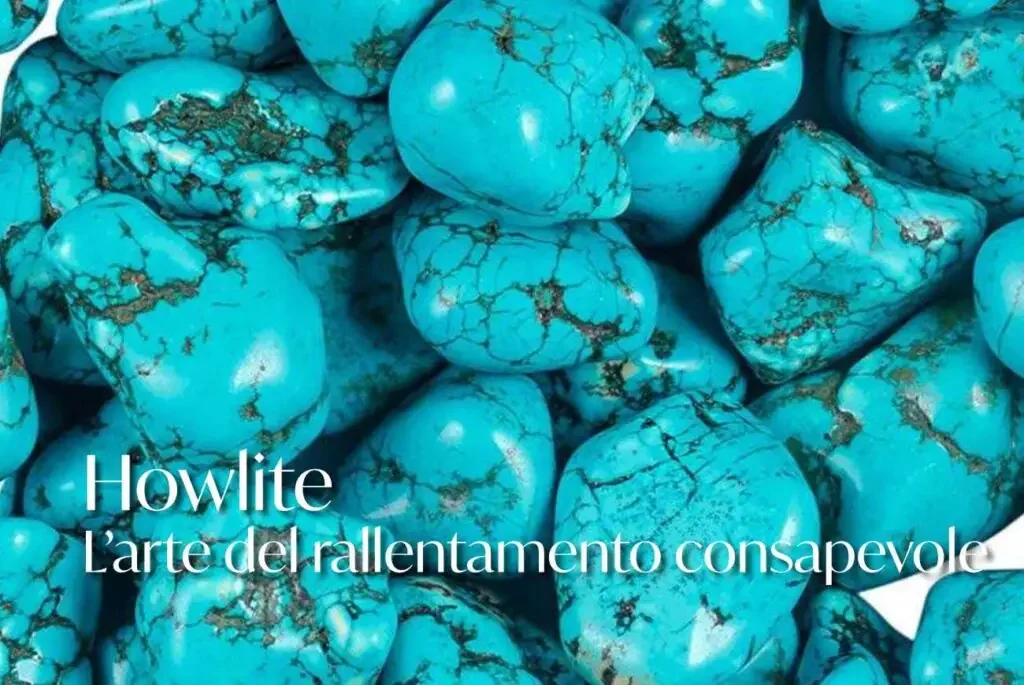
Unlike many minerals that stand out for their brilliance, transparency, or particularly intense colors, howlite possesses a sober and immediately recognizable aesthetic. Its white surface, interspersed with irregular gray or black veins, creates a delicate contrast reminiscent of the natural patterns found in certain sedimentary rocks or marble. This characteristic gives it an elegant and harmonious appearance, devoid of excess, which seems to visually reflect the qualities attributed to it on an energetic level. The presence of the veins interrupts the uniformity of the surface without creating disorder, creating a structure in which different elements coexist in balance.
From a mineralogical perspective, howlite is a hydrated calcium borosilicate and generally forms in boron-rich evaporitic deposits. It was first described in 1868 by Canadian geologist Henry How, whose surname later became the official name of the mineral. Although it is not a particularly rare stone, its porous structure and distinctive appearance have made it highly valued in both jewelry and ornamental processing. Due to its porosity, it is frequently subjected to artificial coloring processes, especially to imitate turquoise, a practice that has contributed to its increased recognition in the international market.
Its geological formation already tells something about the qualities attributed to it by crystal therapy tradition. Howlite is formed through slow and gradual processes that require extremely long periods, during which elements progressively organize until they create a stable and defined structure. Symbolically, this characteristic evokes the concept of inner maturation, that is, the understanding that some changes cannot be forced but need to be accompanied with patience and continuity.
In crystal therapy, howlite is often associated with mental calmness. However, this definition risks being reductive if interpreted simply as the absence of thoughts or a decrease in cognitive activity. Its work is generally described as a progressive harmonization of the inner dialogue, in which thoughts do not disappear but lose part of their capacity to generate agitation and dispersion. The mind continues to perform its function, but it does so in a more orderly and less fragmented manner.
Many people indeed live in a state of constant mental overload. Projects, responsibilities, expectations, worries, and stimuli from the environment tend to accumulate until they create a feeling of continuous pressure that makes it difficult to distinguish what truly requires attention from what merely represents background noise. In these situations, howlite is used as a symbolic and energetic support to promote greater perceptual clarity, helping to refocus attention on what is truly present instead of dispersing it across a multitude of hypothetical scenarios.
One of the most interesting aspects attributed to it concerns the relationship with impulsivity. Often, emotional reactions do not solely arise from the events we experience but from the speed with which we interpret and judge what happens. Between a stimulus and a response, there is always a space, but in daily life, this space tends to shrink until it almost disappears. Howlite is traditionally considered a stone capable of symbolically expanding this distance, fostering greater awareness before action and allowing for a more balanced response to events.
For this reason, it is frequently associated with patience, a quality that in spiritual and philosophical traditions has always been considered much more complex than it may appear. Patience does not consist in passively waiting for something to happen but in the ability to maintain balance and clarity while a process follows its natural course. Howlite evokes precisely this dimension, helping to develop a less conflictual relationship with time and the rhythms of life.
On an emotional level, it is used during times of significant change or periods characterized by uncertainty. When old references fade and new balances have not yet been established, a feeling of instability may arise, leading to a search for immediate solutions or constant confirmations. In these cases, howlite is not seen as a stone that eliminates discomfort but as a symbolic presence that facilitates the conscious navigation of the transition phase, reducing the need to control every aspect of the experience.
The crystal therapy tradition often links it to the management of anger and accumulated tensions. Not because it is considered a stone capable of repressing intense emotions, but because it would promote a greater ability to observe them before they transform into automatic behaviors. In this perspective, its work does not consist of blocking what emerges but in creating the conditions for the emotion to be recognized, understood, and integrated within a broader vision of the self.
Many practitioners also associate it with improving the quality of rest. Sleep difficulties are often accompanied by a mind that continues to produce images, evaluations, and reflections even when the body is naturally trying to slow down. Howlite is traditionally used in evening practices because its energy is considered aligned with processes of relaxation and unwinding, promoting a gradual reduction of the mental tension accumulated throughout the day.
On an energetic level, it is frequently linked to the crown chakra, the center that represents the connection with the higher dimension of consciousness. However, its action is not interpreted as a push towards extraordinary experiences or particularly intense mystical states. Rather, howlite is associated with a form of simple and stable awareness, in which understanding emerges through inner silence and not through the continuous accumulation of information or stimuli.
In esoteric contexts, this stone has often been associated with wisdom and self-knowledge. The white color that characterizes it symbolically evokes the concepts of purity, clarity, and integration, while the dark veins that traverse its surface seem to remind us that every growth path inevitably includes elements of complexity and shadow. True harmony does not arise from the elimination of contradictions but from the ability to recognize and integrate them within a broader and coherent structure.
Some contemporary traditions use it during meditation, contemplation, or personal introspection practices. In these contexts, it is considered a support for maintaining focused attention and for reducing the mind's tendency to shift continuously between past and future. The goal is not to reach a particular state but to develop a more stable presence concerning what happens in the present moment.
Another aspect that makes it particularly interesting is its symbolic relationship with control. Many of the tensions we experience indeed stem from the attempt to govern aspects of reality that do not directly depend on us. When this happens, a continuous inner struggle arises between expectations and reality, between desire and acceptance. Howlite is traditionally associated with the ability to recognize this mechanism and to gradually loosen it, fostering a more fluid relationship with what cannot be immediately modified.
For these characteristics, it can be considered a stone of listening. Not just listening directed outwardly, but especially that which pertains to one’s inner world. In a society that constantly values speed, productivity, and immediate reaction, howlite evokes the value of mindful pause, observation, and reflection. It does not suggest withdrawing from reality but entering it with greater clarity and presence.
Its energy is generally perceived as gentle yet constant, capable of accompanying gradual and profound inner processes without creating abrupt accelerations. It is a stone that seems to teach the value of continuity more than that of intensity, reminding us that often the most lasting changes are not those that happen suddenly but those that mature slowly over time.
In this perspective, howlite represents much more than a simple stone associated with calm. It becomes the symbol of a different relationship with oneself, with time, and with daily experience. A relationship in which clarity arises from observation, stability from acceptance, and growth from the ability to proceed without haste but without interruption. In a world that continually pushes towards acceleration, its deepest teaching seems to be this: true strength does not always consist in going faster but in knowing when to slow down to regain direction.