The Morrigan
Sovereignty, War, and Destiny in Pre-Christian Ireland's Religion: The complex identity of the most enigmatic deity of ancient Ireland.
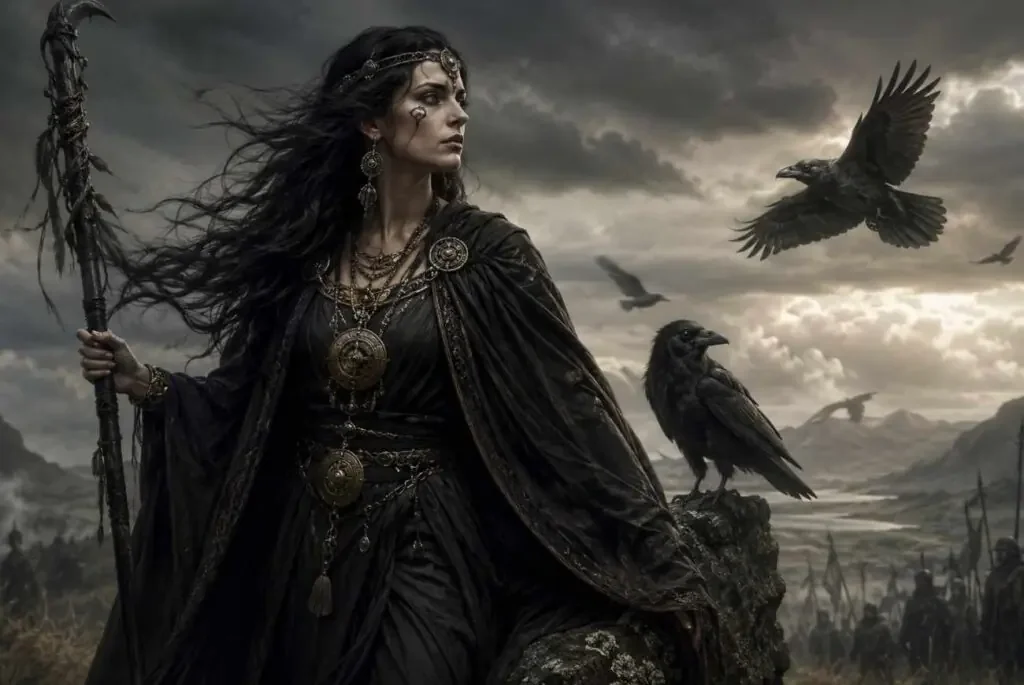
Sovereignty, War, and Destiny in Pre-Christian Ireland's Religion
Between Myth, Sacred Kingship, and Prophecy: The Complex Identity of the Most Enigmatic Deity of Ancient Ireland
"Peace to the sky, sky to the earth, earth beneath the sky." — Cath Maige Tuired
Introduction
Among all the figures belonging to the mythological heritage of ancient Ireland, few have experienced an interpretative fortune comparable to that of the Morrigan. Over the last two centuries, her name has been associated with an extraordinary variety of meanings: goddess of war, lady of death, queen of the underworld, protector of witches, deity of magic, and even embodiment of destruction.
Such definitions, however widespread, do not always find direct correspondence in the available historical sources.
The Morrigan indeed represents one of the most significant cases of distance between ancient documentation and modern interpretation. Many of the characteristics attributed to the goddess today derive from romantic, neopagan, or esoteric reinterpretations developed between the 19th and 21st centuries. The medieval Irish testimonies, however, return a much more complex figure, deeply rooted in the concepts of sovereignty, destiny, prophecy, and cosmic order.
Understanding the Morrigan thus means confronting an important methodological challenge: distinguishing what emerges from the sources from what belongs to later elaborations.
The aim of this study is not to deny the value of contemporary interpretations but to reconstruct, as far as possible, the role that the goddess occupied within the religious imagination of pre-Christian Ireland.
To achieve this goal, it is necessary to critically examine the medieval sources, the historical context in which they were written, and the contributions provided by modern academic research.
Only through this perspective is it possible to restore to the Morrigan her authentic complexity, freeing her from both popular simplifications and excessively romantic readings that have characterized her modern reception.
The Sources and the Limits of Reconstruction
One of the fundamental problems in the study of Celtic religion is the absence of texts written directly by the pagan populations of ancient Ireland.
Unlike the Greek and Roman civilizations, the insular Celts entrusted much of their religious tradition to oral transmission. When the Irish mythological heritage was finally written down, the island had already been Christianized for centuries.
The main sources mentioning the Morrigan were compiled between the 11th and 14th centuries by authors belonging to the monastic environment. Among these, the Lebor Gabála Érenn (Book of the Invasions of Ireland), the Cath Maige Tuired (The Battle of Mag Tuired), the Táin Bó Cúailnge (The Cattle Raid of Cooley), and the collections known as Dindshenchas assume particular importance.
These works cannot be considered religious documents in the modern sense of the term. They rather constitute a complex synthesis of oral traditions, literary elaborations, genealogical interests, and Christian reinterpretations.
Consequently, any attempt to reconstruct the Morrigan must proceed with extreme caution.
Scholars, however, agree that these texts preserve numerous elements belonging to a much older tradition. Behind the medieval literary guise, it is still possible to recognize symbolic structures that have their roots in pre-Christian Ireland.
The Morrigan appears precisely as one of the figures in which such elements are most preserved.
The Etymology of the Name
Even the name of the goddess continues to provoke debate.
The most accredited interpretation links the term Morrigan to the Old Irish Mór-Ríoghain, generally translated as "Great Queen" or "Great Sovereign."
This reading has the advantage of harmonizing with the role that the deity seems to play within the sources, where the theme of sovereignty constantly emerges.
Some scholars have proposed alternative interpretations, suggesting connections with terms referring to spectral presences or supernatural manifestations. However, none of these hypotheses has reached a consensus comparable to that of the royal etymology.
The uncertainty itself constitutes a significant datum.
It indeed suggests the extreme antiquity of the figure, whose origin may precede by many centuries the written fixation of the traditions concerning her.
A Goddess or a Divine Multiplicity?
One of the most enigmatic aspects of the Morrigan concerns her identity.
The sources do not offer a univocal answer.
In some tales, she appears as a clearly distinguishable individual deity. In others, she seems to be part of a triad including Badb and Macha, sometimes accompanied by Nemain.
Far from being a contradiction, this ambivalence reflects a characteristic widely documented in Celtic religions.
Many deities appear simultaneously as individuals and as multiple manifestations of the same sacred force.
The Morrigan could thus represent not so much a single divine personality but a complex configuration of powers connected to sovereignty, prophecy, and war.
This interpretation is supported by the extraordinary fluidity with which the various female figures associated with the goddess overlap and replace each other within the medieval narratives.
More than a simple triad, the Morrigan seems to embody a form of multiple unity typical of Celtic spirituality.
Sacred Sovereignty and Legitimization of Power
To understand the role of the Morrigan, it is necessary to comprehend the significance that sovereignty held in the Celtic societies of ancient Ireland.
In the modern world, power is generally interpreted as an administrative, military, or legal matter. In pre-Christian Irish society, however, kingship possessed a deeply religious dimension.
The sovereign was not merely the ruler of a community. He represented the meeting point between the territory, the people, and the sacred world.
The prosperity of the land, the fertility of livestock, political stability, and social order were perceived as direct consequences of the correct relationship between the king and the divine forces.
In this context, sovereignty did not belong to the man who governed. It belonged to the land itself.
Many scholars have highlighted how numerous Irish female deities represent personifications of the territory and its sacred legitimacy. The ideal sovereign does not conquer sovereignty: he receives it.
The Morrigan seems to fit precisely within this symbolic system.
The sources do not simply describe her as a warrior goddess. She appears rather as a presence capable of confirming or denying the validity of human authority.
Her connection with the fate of kings suggests a function that transcends military conflict and lies within the sphere of the cosmic legitimization of power.
For this reason, her figure cannot be understood exclusively through the language of war. War constitutes only one of the instruments through which the deeper principle of sovereignty manifests.
The Morrigan and the Battle of Mag Tuired
Among the sources that mention the Morrigan, the Cath Maige Tuired occupies a central position.
The work narrates the conflict between the Tuatha Dé Danann and the Fomori, two supernatural groups that embody opposing forces within the Irish mythological universe.
The battle does not merely represent a military clash.
It assumes the value of a struggle for the restoration of cosmic order.
In this context, the Morrigan plays a fundamental role.
The goddess participates in the events not as a combatant but as a prophetic and regulatory presence.
After the victory of the Tuatha Dé Danann, she proclaims a series of announcements that describe the return of harmony between heaven, earth, and human society.
This detail is of extraordinary importance.
If the Morrigan had been simply a goddess of destruction, her role would have concluded with the battle.
On the contrary, the sources show her engaged primarily in the restoration of balance following the conflict.
War does not appear, therefore, as the end of her action.
It represents rather the means through which order is restored.
Cú Chulainn and the Confrontation with Destiny
The relationship between the Morrigan and Cú Chulainn constitutes one of the most studied themes of medieval Irish literature.
In the Táin Bó Cúailnge, the goddess meets the hero taking the form of a young woman.
The episode is often superficially interpreted as the rejection of a romantic proposal.
A more attentive reading, however, suggests much deeper meanings.
The female figure that presents herself to the hero seems to embody a form of sacred sovereignty. By rejecting her, Cú Chulainn does not merely dismiss a woman but a relationship with the cosmic principle that she represents.
From that moment, the Morrigan takes on various animal forms and intervenes repeatedly in the story.
Eel, wolf, and heifer are not mere disguises.
In Celtic symbolism, these animals possess specific associations with territory, strength, and the wild dimension of nature.
Through these transformations, the goddess manifests her ability to act on multiple levels of reality.
The episode culminates in one of the most famous images of Irish mythology: the raven perched on the shoulder of the dying hero.
This scene has often been used to support the idea that the Morrigan was a goddess of death.
The sources, however, do not assert this.
The raven does not cause Cú Chulainn's death.
Her presence rather signals that the hero's fate has now been fulfilled.
The Symbolism of the Raven
No symbol is more associated with the Morrigan than the raven.
To understand the meaning of this connection, it is necessary to avoid modern interpretations influenced by exclusively funerary conceptions.
In ancient societies, the raven was an animal observed closely for its intelligence, adaptability, and presence in places marked by conflict.
Its association with the battlefield did not stem from a macabre view but from the observation of its presence at moments when the fate of communities was decided.
In the Irish context, the raven assumes an even more complex symbolic function.
It becomes the sign of knowledge that transcends human limits.
When the Morrigan appears in the form of a raven, she does not simply represent death.
She represents the awareness of completion.
She observes the moment when a process reaches its conclusion and a new balance takes shape.
This function is perfectly coherent with the role of the goddess as a guardian of fate and sovereignty.
One of the most fascinating characteristics of the Morrigan is the continuous mutability of her manifestations.
The goddess takes on human and animal forms, changes appearance, crosses boundaries, and eludes any stable definition.
In traditional religions, metamorphosis does not simply represent a supernatural power.
It constitutes a symbolic language.
Deities that change form manifest their ability to transcend ordinary categories of existence.
The Morrigan appears precisely as a force that cannot be confined within a single identity.
Her essence coincides with change.
She appears at moments of transition between order and chaos, between peace and war, ...