The Mystical Significance of the Strait of Messina
Explore the mystical significance of the Strait of Messina, where myth, initiation, and the sacred converge, revealing profound insights into transformation and the human experience.
Scilla, Charybdis, and the Fairy Morgana: The Mediterranean Portal of Myth, Initiation, and Mystery
The Strait of Messina transcends its identity as merely a maritime passage; it stands as a threshold. For millennia, sailors, priests, fishermen, and poets have recognized these waters as a realm distinct from the rest of the world. Here, the sea behaves in extraordinary ways. Currents clash, depths shift abruptly, the earth trembles, horizons distort, and cities seem to float in the sky. The ancient peoples did not perceive these phenomena as mere natural curiosities; they regarded them as manifestations of the sacred. To grasp the true essence of the Strait, one must look beyond geography and delve into the language of myth.
Before the Myth: The Sacred Sea
Long before Homer penned the Odyssey, the Strait was already a revered site. The pre-Hellenic populations of Sicily and Calabria lived in close communion with the sea and its forces. For the ancients, the sea was not just an environment; it was a living deity. Each current bore a spirit, every promontory housed a presence, and every whirlpool held a will. When the Greeks arrived, they encountered an existing symbolic heritage, which they integrated into their own cosmology. The legends of Scilla and Charybdis may represent the Hellenic transformation of even older traditions, now lost to time.
Scilla and Charybdis: The Dual Faces of Trial
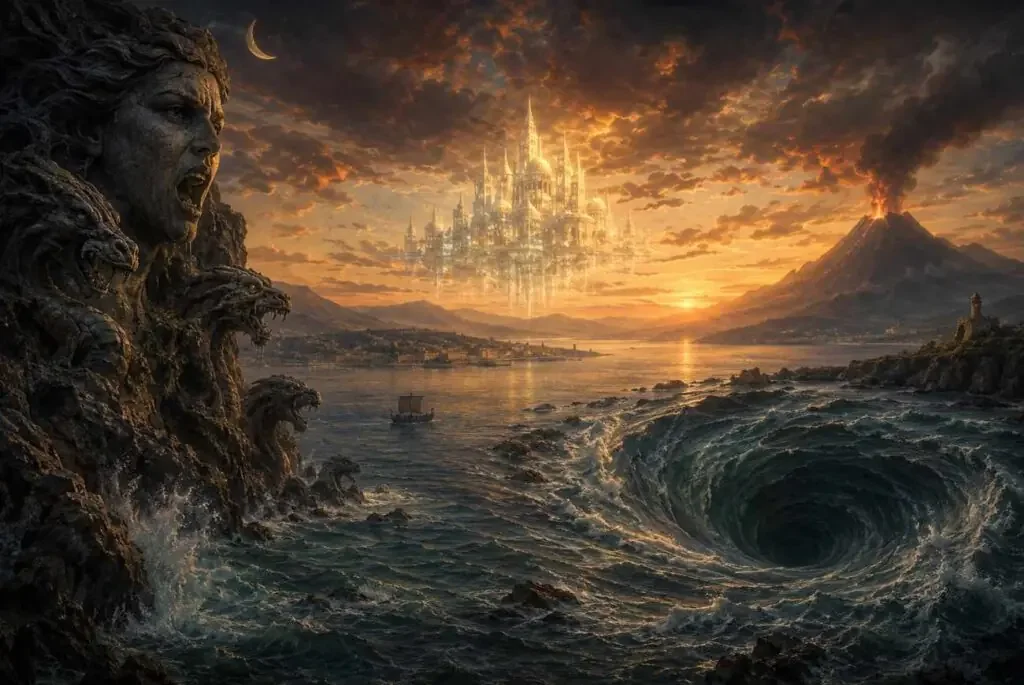
In the Odyssey, Odysseus must navigate the passage guarded by Scilla and Charybdis. Geographically, these two monsters embody the real dangers of navigation. Symbolically, however, they represent something far deeper. In initiatory traditions, there is often a "narrow gate" that divides the ordinary world from the realm of knowledge. This gate is typically guarded by two opposing forces, not one but two.
This duality appears in:
- Egyptian Mysteries;
- Alchemy;
- Kabbalah;
- Heroic tales of antiquity;
- Shamanic traditions.
Scilla and Charybdis embody this polarity. Scilla represents the fear that attacks, while Charybdis signifies the chaos that consumes. Scilla devours, and Charybdis swallows. Scilla compels one to react, whereas Charybdis urges surrender. Authentic transformation inevitably traverses these two forces.
The Waters of Transformation
The Strait is one of the few places in the Mediterranean where one can clearly observe the conflict between different bodies of water. The currents from the Ionian and Tyrrhenian seas converge, generating whirlpools, upwellings, and phenomena that seemed supernatural to ancient observers. In esoteric thought, water symbolizes the unconscious. When two currents meet, two aspects of consciousness interact. The entire Strait can be interpreted as a colossal alchemical image: the lower water meets the upper water, the shadow confronts the light, the old meets the new, and the personality encounters the soul. The initiate crosses the sea not merely to reach a destination but to undergo transformation.
The Fairy Morgana: Mistress of the Veil
While Scilla and Charybdis represent trials, Morgana embodies mystery. The optical phenomenon known as the Fairy Morgana is real and can still be witnessed under specific atmospheric conditions. However, what captivates us is not just the physical occurrence but the meaning humans have ascribed to it. Cities suspended in the sky, radiant castles, and towers emerging from the sea are images that appear and vanish — visions that seem real yet are not. Thus, Morgana becomes the personification of illusion, the Queen of the Threshold, revealing and concealing, showing and deceiving.
Morgana and the Archetype of the Great Goddess
In the history of religions, a figure emerges repeatedly under various names: the Lady of the Waters, the Queen of the Other World, the Guardian of the Threshold. Morgana belongs to this archetypal lineage, akin to Greek Nymphs, Celtic Matres, and ancient Mediterranean Sea Goddesses. She symbolizes the Sacred Feminine in its initiatory form—not as mother or lover, but as the guide through mystery.
The Strait as an Axis Between Worlds
Many sacred sites around the globe are situated at points of transition: mountains, islands, deserts, caves, and straits. Ancient symbolic thought viewed such places as contact points between different levels of reality. The Strait of Messina possesses all the characteristics of a liminal center: it unites two seas, separates two lands, generates extraordinary optical phenomena, is associated with monsters, deities, and apparitions, and has historically served as a crossing point. For this reason, it can be considered one of the most significant symbolic landscapes of the Mediterranean.
The Hidden Meaning of the Strait
In esoteric language, Scilla, Charybdis, and Morgana are not mere characters; they are inner states. Scilla represents the fear that hinders change, Charybdis is the abyss of attachment that keeps one anchored in the past, and Morgana is the illusion that distracts from the path. The Strait serves as the initiatory journey. To traverse it signifies leaving behind a previous condition to access a new form of consciousness. This is why these figures continue to resonate with us over two millennia later. They do not solely belong to the geography of Calabria and Sicily; they belong to the geography of the soul.
Conclusion
Perhaps the greatest secret harbored by the waters of the Strait pertains not to sea monsters, fairies, or ancient legends but to human beings themselves. Each time we face a significant transformation, we enter the Strait. Before us appears Morgana, to our right stirs Scilla, and to our left opens Charybdis. Like Odysseus, we are called to move forward. For the true journey does not merely lead from one shore to another; it leads from one version of ourselves to another.
Essential Bibliography
Homer, Odyssey, Book XII.
Strabo, Geography, Book VI.
Pliny the Elder, Natural History.
Mircea Eliade, The Sacred and the Profane.
Arnold Van Gennep, The Rites of Passage.
Victor Turner, The Ritual Process.
Carl Gustav Jung, The Archetypes of the Collective Unconscious.
Jean Chevalier & Alain Gheerbrant, Dictionary of Symbols.