The Devil's Door
Turin, 1675. In a city renowned for its occult reputation, a wooden door becomes a haunting symbol, entwined with legends of dark forces and mysterious occurrences.
Turin, 1675.
In a city that has long held the reputation of being the capital of the occult — traditionally positioned at the apex of the triangles of both white and black magic — a wooden door becomes one of its most unsettling images.
It is located at Via XX Settembre 40, at the corner with Via Alfieri, and serves as the entrance to the Palazzo Trucchi di Levaldigi. It was commissioned by Giovanni Battista Trucchi di Levaldigi: count, general of finance for Carlo Emanuele II of Savoy, a man who held the contracts, credits, and favors of the duchy in his hands. A power that, as always, came with the weight of malicious gossip. Rumors circulated about riches accumulated behind the duke's back in ways that were not entirely lawful… Of course, they were just rumors. But at court, whispers have always carried the weight of truth.
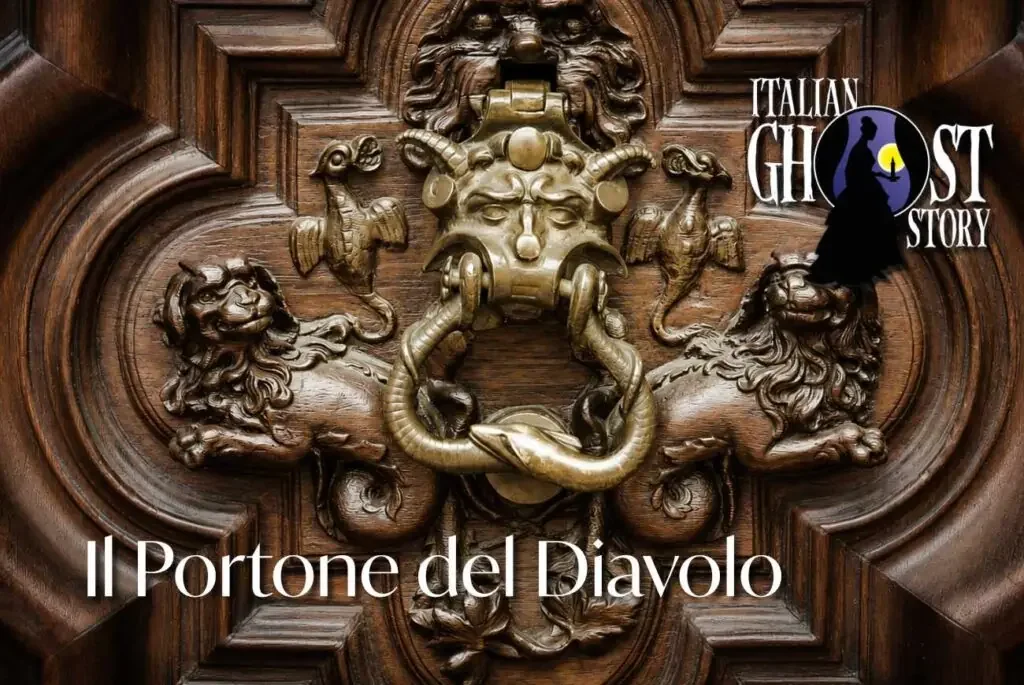
The count responded in his own way: he commissioned a palace in Turin from architect Amedeo di Castellamonte and, in 1675, entrusted the door to artist Pietro Danesi. The result was a masterpiece carved in wood: flowers, fruits, cherubs, two serpents intertwining and converging into a knocker. And at the center of it all, the face of the Devil.
That face was a message. Tradition holds that it depicted the very malicious tongues of which Trucchi claimed not to be afraid. As if to say: speak freely, even the Devil is on my side.
Then the legend was born. It is said that the door was not built, but appeared in a single night. An apprentice sorcerer allegedly invoked dark forces, calling them with words in a language unknown to humankind, until someone responded: not just any demon, but the “first proud one” himself. Annoyed by that clumsy invocation, the Devil punished him by imprisoning him behind the door, walled up alive for eternity, never able to open it from the inside.
Coincidences, after all, were not lacking. Before hosting the National Labor Bank, the palace was home to the Royal Tarot Factory: one of the oldest divination tools in the West, produced right behind that sculpted face. At the time, the civic number was 15… and 15, in the Tarot, is the Major Arcana of the Devil.
Dark stories multiplied. In 1790, during a carnival celebration, a dancer fell to the ground stabbed in the back: a single blow, the weapon never found, the culprit never identified. That same night, a sudden storm struck Turin, and a cold wind, with windows closed, extinguished every candle. In the following days, someone swore they saw the ghost of the dancer wandering through the rooms; others recounted a painting never seen before, appearing on a wall, depicting a woman dancing among the flames of hell.
A few years later, under French occupation, Major Melchiorre Du Perril entered the palace for a quick meal, carrying secret documents. He never came out. Twenty years later, while demolishing a wall during renovation work, some workers found a skeleton standing, walled up. No trace of the documents.
The imprisoned sorcerer, the dancer without a murderer, the major without a grave.
The most rational will remember that the door was commissioned and carved by human hands, and that the rest is folklore layered over the centuries. Yet, even today, there are those who swear they perceive something wrong when passing by that area: the sensation of being watched by something unseen.
Meanwhile, the Devil on the knocker smiles. And waits.