
The Enigmatic Presence of the Black Man
Exploring the enigmatic figure of the Black Man, a shadowy presence rooted in folklore that transcends cultures and generations, revealing deeper truths about humanity's relationship with the unknown.
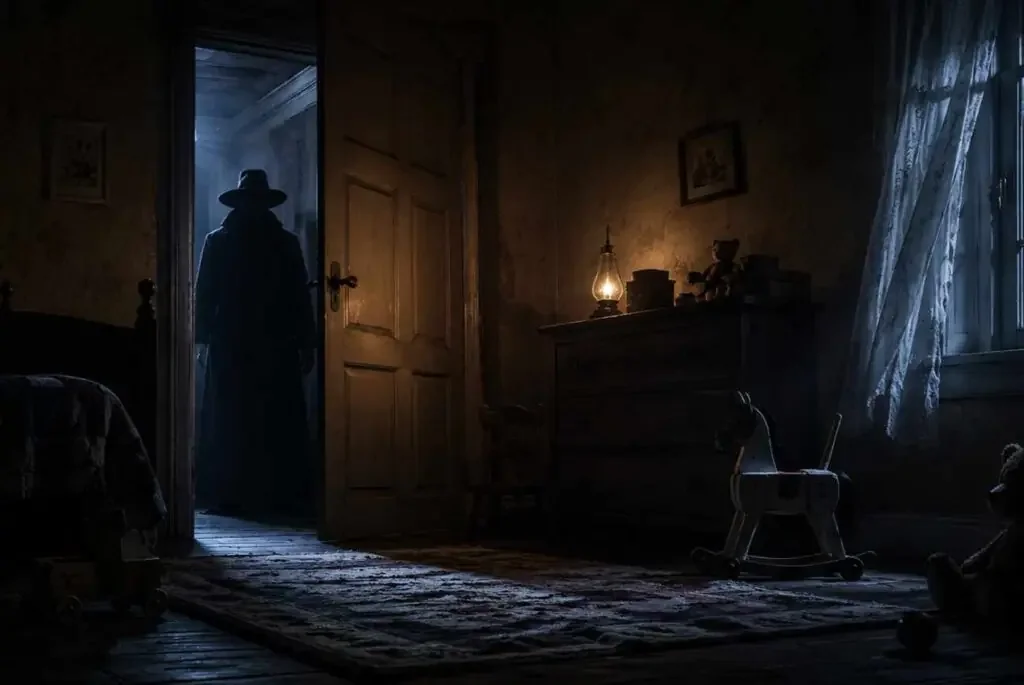
As twilight descends, hallways can appear deceptively elongated. The faint light filtering from an adjacent room fails to illuminate the last door, leaving the wardrobe in the corner of the room shrouded in mystery. Any sound—a creaking floorboard, a fluttering curtain, or a rattling shutter—can ignite the imagination, conjuring the notion that something awaits in the shadows. Though never truly seen, this presence is known by many.
"Lullaby, lullaby, oh, to whom shall I give this child? I will give it to the Black Man, who will keep it for a whole year..."
It is challenging to pinpoint the first time we heard this nursery rhyme. Perhaps it was while perched on a grandparent's lap, during preschool, or casually recited by someone who could not recall its origins. Nursery rhymes possess a unique quality; they traverse generations without permission, morphing slightly with each telling, yet they continue to evoke images that feel ancient, far older than the speaker.
Among these rhymes, the tale of the Black Man holds a peculiar significance. It does not promise rewards, nor does it feature talking animals, fairies, or princesses. Instead, it evokes a dark, unknown presence to which a child might even be surrendered. This imagery, seemingly cruel today, was once sung with the same ease as daily rituals. No one paused to question the identity of this figure; merely naming him sufficed, as if everyone inherently understood without truly knowing.
And herein lies the beginning of the mystery.
The Black Man transcends mere childhood memories. He is not simply a fabrication conjured by adults to coax children into sleep or to keep them close to home. The deeper one delves into his lore, the more elusive this figure becomes. He traverses Italy under various names, crosses mountains, spans Europe, and emerges in different languages, yet retains the same shadowy characteristics. It is akin to observing an ancient shadow that has roamed the continent for centuries, altering its visage yet never vanishing.
The Italian Babau, the English Boogeyman, the Spanish Coco, the French Croque-mitaine, and the German Sackmann may appear different, but they share an underlying essence. Each character springs from local traditions, yet they all seem to preserve the memory of something far older. It is difficult to believe that such diverse cultures independently envisioned the same nocturnal presence. It is far more plausible that they inherited and gradually transformed a pre-existing symbol.
This is where the exploration becomes truly fascinating. Tracing this figure backward leads us away from children’s bedrooms and into the woods of pre-Christian Europe, along paths once taken by processions of the dead, beside hearths where offerings were made to ancestral spirits, during nights when the boundary between the living and the invisible was believed to thin.
The Black Man may not have originated as a means to frighten children.
It was adults, much later, who redefined him as a cautionary figure.
Long before Christianity assigned a face to the Devil, Europe was inhabited by entities belonging to the night—spirits of the woods, restless souls, liminal beings, chthonic deities, guardians of forbidden places. Some protected springs, others safeguarded forests, while still others marked the boundary between the village and the unknown beyond the last cultivated field. These beings were not inherently malevolent; they simply represented the other half of existence.
This detail is one that modern folklore has nearly forgotten. The Black Man does not equate to the Christian devil. The conflation of these figures occurred relatively late in history. During the Christianization process, many ancient presences were reinterpreted as demonic manifestations, and what once belonged to the sacred landscape of nature gradually became associated with evil.
Yet legends are tenacious beings.
Even as their meanings shift, they retain fragments of their origins.
Thus, the Black Man continues to arrive with the cover of darkness. He does not break down doors, leave footprints, or possess a clearly defined face. He embodies more of a presence than an individual. It is this very ambiguity that has ensured his survival. Each generation has envisioned him in its own way, cloaking him in the fears of its time without altering his essence.
Even the darkness implied in his name tells a different story than we might assume. In esoteric traditions, black is not merely the color of evil; it represents fertile earth, depths, the invisible womb, and formless matter. Alchemists referred to nigredo as the initial phase of the Great Work, where everything seems to dissolve before the possibility of rebirth. In mystery religions, night is not solely a realm of fear; it is also a space of initiation. What is hidden is not necessarily hostile; it is, above all, unknown.
Perhaps this is precisely why the Black Man continues to walk alongside our imagination. Not because he exists, but because darkness, uncertainty, and that part of humanity that prefers to assign a face to the unknown rather than accept its silence still endure.
Legends persist not because they recount actual events, but because they convey something profoundly true about those who pass them down.
And the Black Man, more than many other figures in European folklore, seems to remind us that every civilization must eventually find a name for what it cannot explain.
Before closing these pages, allow me to share a curiosity.
You may have smiled while reading these lines, perhaps recalling an old nursery rhyme, or convincing yourself that it is merely a story.
But when you enter your room tonight, with the light turned off, and for a brief moment the hallway seems a bit longer than usual...
…are you quite sure you won’t take a quick look under the bed?