The Magistrate and the Priest
Popular witchcraft in Southwestern France, between Béarn and Gascony. On the eve of Saint John the Baptist's feast, housewives took protective measures against sorcery, revealing a rich tapestry of local beliefs.
Popular Witchcraft in Southwestern France, Between Béarn and Gascony
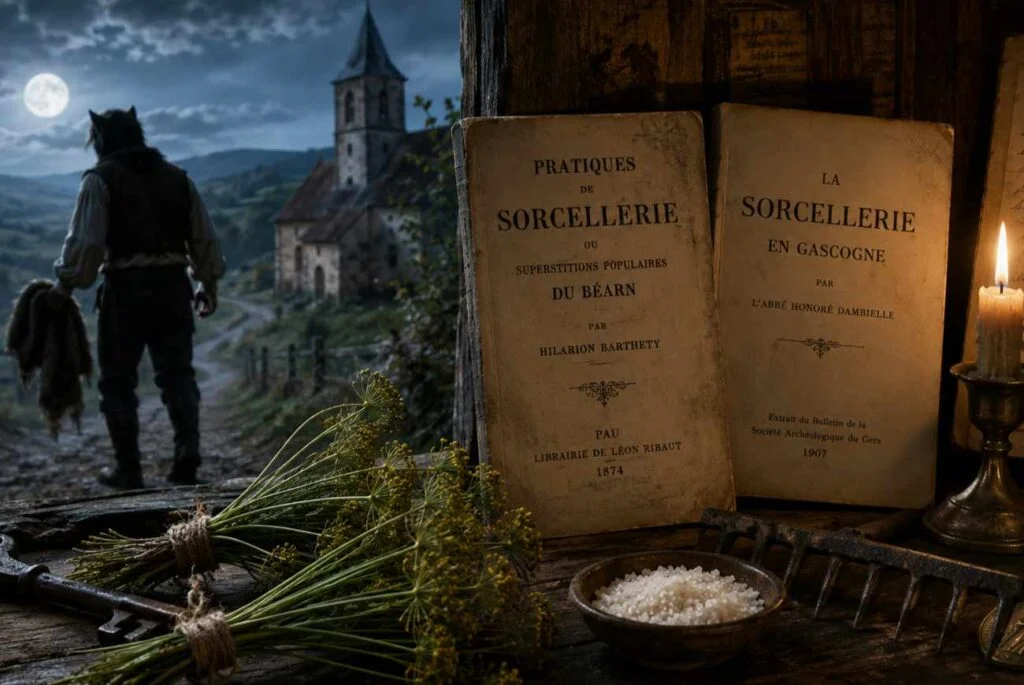
In the countryside of Béarn, on the eve of the feast of Saint John the Baptist, housewives would lock their doors with small bundles of fennel and block the keyholes. It was a widely held belief that on that night, sorcerers multiplied in zeal and malice, capable of shrinking themselves to infiltrate the narrowest crevices of the rural home; fennel then served as a plant sentinel, and a formula in the Béarnese language ensured its nocturnal vigilance: Si passa peu hourat, a noeyt, nat sourcièr boü, / Hè-t plaa senti, fenoulh, et d’entra qu’haura poü. Three hundred kilometers further north, in the flat Gascony of Gers, a shepherd who might cross paths with a loup-garoun under the moonlight knew that the duel would begin with the challenge formula Tiro-t’ la besto: once uttered, the creature was forced to shed its peau — the feral skin that made metamorphosis possible — and the werewolf would return to being human.
This was still the world of rural French life between the late 19th and early 20th centuries; it was still, above all, a world that could be observed live, not reconstructed from archives. Two small volumes, now translated for the first time into Italian in the Sorcellerie series of Lexicon Symbolorum, capture its physiognomy from two different yet complementary observers.
The first is from 1874. It is titled Pratiques de sorcellerie ou superstitions populaires du Béarn; it is authored by Hilarion Barthety, who at that time was thirty-two years old and a notary in the canton of Garlin, at the northern foothills of the Pyrenees. In that same year, he was appointed mayor of his municipality and deputy justice of the peace, which put him in daily contact, between a deed and a sales contract, with the farmers of the rural fractions of Vic-Bilh. It is while seated at the notary's desk or in the office of the justice of the peace that the young magistrate collects the formulas that he later writes down: the booklet is the literal byproduct of a public function. Published in Pau by the bookseller Léon Ribaut as an extract from the Bulletin de la Société des Sciences, Lettres et Arts de Pau, the pamphlet was not the work of folkloric scholarship conducted at a desk but rather a collection of notes from a magistrate who listens.
The second book is from 1907. It is titled La Sorcellerie en Gascogne by Abbot Honoré Dambielle, who authored it at thirty-three years old, having been a parish priest for less than a decade in a village in Gers, and an amateur archaeologist for the publications of the learned society of Gascony. The thirty-six-page pamphlet is an extract from an essay that appeared in two installments in the Bulletin de la Société archéologique du Gers between autumn 1906 and winter 1907. Here too, the observer's position is dual and generates fruitful tensions: Dambielle speaks the same language as his parishioners, knows the formulas he describes from within, frequents the same domestic spaces where healing prayers are said and blessed amulets are hung; yet he frames them through the lens of the orthodox priest who views superstition as a religious deviation to be unmasked, and the concluding invitation to "fight against superstition" closes the pamphlet like a pastoral warning.
What strikes one, reading the two works side by side, is the different angle of vision. Barthety writes as a magistrate: his interest lies in defensive practices, that is, the ritual devices with which the Béarnese farmer seeks to neutralize the actions of the sourcièr. It is a paradoxically domestic repertoire, made up of minimal gestures, murmured formulas, herbs, and blessed candles, of saliva mixed with salt in the hollow of the left hand. The bent thumb between the index and middle fingers renders harmless the sorcerer encountered on the road; the fennel at the window intercepts his metamorphosis; a nine-pronged rake, placed under the newborn exposed for a moment to the pigsty bedding, returns the cry to the tentadou, the tempter, who had induced it. Therapeutic recipes occupy half of the booklet and describe a universe of charms against fever (seven feet of mendras, wild mint, to which bread and salt are offered in equal parts of seven or nine crumbs, in accordance with the Virgilian precept number Deus impare gaudet), against scabies (to be cured by walking naked before sunrise in an oat field on Saint John's day), against cindre (herpes zoster, which the healer "carries" and "deposits" in nine steps on his own shoulders), against passerie (infant thrush, to be resolved by dipping the infant's head nine times into the door of a henhouse). The magistrate records with a light positivist irony, and with a pedagogical concern that today seems almost naive.
Dambielle has a different obsession. More than the defensive practices, he is interested in the physiognomy of those that make them necessary. The first part of his book is a taxonomy of the sorcier: the pousoè of the Gascon dialect, the sorcerer proper, and alongside him the doubin, the diviner-mage who consults a large book held upside down; the sorcier-médecin, the healer-sorcerer who mixes effective herbs and malevolent formulas; the feared sorcier-prêtre, the ordained priest who has made a pact with the devil and celebrates the messe de Saint Sécaire at midnight in a ruined church inhabited by owls and toads, to cause his victim to die a slow death. The saint, in reality, is purely a popular invention: the name is etymologically constructed from the Gascon secà, "to dry, to make dry," designating the evil that slowly drains the strength of its object. The four ways to obtain powers are meticulously codified: family inheritance, pact with the devil, possession of the peau – the diabolical skin that is transferable, sometimes inherited, sometimes acquired – and finally the reading of popular grimoires, notably the Petit Albert and the Grand Albert, which Barthety declared thirty years earlier to have "thrown into the fire" in the homes where he found them, without realizing that he was himself acting as an active agent of the cultural deforestation he was merely recording.
The nocturnal metamorphoses, in Dambielle, form a chapter of their own. The camo cruso, the black mare, the female vampire that crosses through the walls of houses at night to steal children from their sleep, cohabits in the Gascon pantheon with the loup-garoun, the werewolf that allows itself to be challenged at the crossroads, and with the revenants, as morts que tournon, the dead who return and manifest through las lutzes (the lights seen at night on walls), through las candelos (the candles that light themselves), and through the brut (the noises that strike the furniture at midnight). The second part of the book describes the enormous repertoire of preventive Catholic means of popular healing, from the paschal candle to blessed bread, from the halhèro of Saint John to the wax of Candlemas, up to invocations to Saint Apollonia for toothaches, to Saint Fiacre for hemorrhoids, to the three Maries for difficult births, to Saint Barbara for lightning, to Saints Cosmas and Damian for illnesses in general.
Read side by side, the two books compose a coherent geography. The Pyrenees and the Plain, magistrate and priest, charmers and pousoè: the combined reading returns to the Italian reader the fabric of a Southwestern France where the agrarian culture of the Occitan language still constituted, at the beginning of the new century, the main fabric of ordinary life, before the demographic transformations of the post-war period significantly thinned its weave. The two works also support each other methodologically. Barthety's generation was that of Paul Raymond and Vastin Lespy, the scholars of Pau who, from the mid-1870s, reconstructed from the Béarn archives a historiographical diptych in which the archive of trials (Lespy, Les sorcières dans le Béarn 1393-1672, Pau 1875) was paired with contemporary rural customs (Barthety, 1874). Dambielle's generation, on the other hand, was that of Paul Sébillot, author of the four volumes of Folk-lore de France (Paris 1904-1907), and Pierre Saintyves, author of Les Saints, successeurs des dieux (Paris 1907): the final maturation of European comparative folklore, applied no longer to literary abstractions but to the daily life of a specific region, all concentrated in the same three or four years.
It remains to say why, today, it is worth recovering two booklets of this kind. The answer does not lie in their potential antiquarian charm, the idea that they can be read like one flips through a print album or a catalog of curiosities, but in a methodological reason. The 20th century dismantled the positivist framework within which Barthety and Dambielle themselves worked. Where the notary of Garlin saw "gross errors" destined to extinguish under the light of compulsory education, Ernesto De Martino showed, in Sud e magia (Feltrinelli, Milan 1959) and La Terra del rimorso (Il Saggiatore, Milan 1961), that practices seemingly identical to those of Béarn — the spell, the "taking," the charm — respond to a precise anthropological function: to guarantee the peasant subject a margin of "presence" in the face of illness, mourning, famine, against the anguish of not being able to be there. Where Abbot Dambielle limited himself to recording the formula as superstition to be fought, Carlo Ginzburg taught, from I benandanti (Einaudi, Turin 1966) to Storia notturna (Einaudi, Turin 1989), to read these same practices as layers of long-lasting culture, in which pre-Christian memories act that were never fully absorbed by official Christianity.
In this light, the nursery rhymes of the Trufandèc – the mocking spirit that Béarn housewives feared in their ovens during Saturday's dough preparation -, the four ways of the pousoè, the duel at Tiro-t’ la besto with the Gascon werewolf, the sourcièr-prêtre who says mass for the death of an enemy, the nine-pronged rake under the crying newborn, cease to be antiquarian curiosities and become witnesses of a symbolic grammar, that of European popular magic, which has its rules, its constants, its internal coherence. Recovering Barthety and Dambielle today means then transforming them: from agents of cultural deforestation that they were in life, into primary sources of knowledge that their own generation sought to erase. It is a small, posthumous justice.