
The Pomegranate
The fruit that holds the mysteries of life, death, and rebirth. Explore the esoteric significance of the pomegranate in spirituality and mysticism.
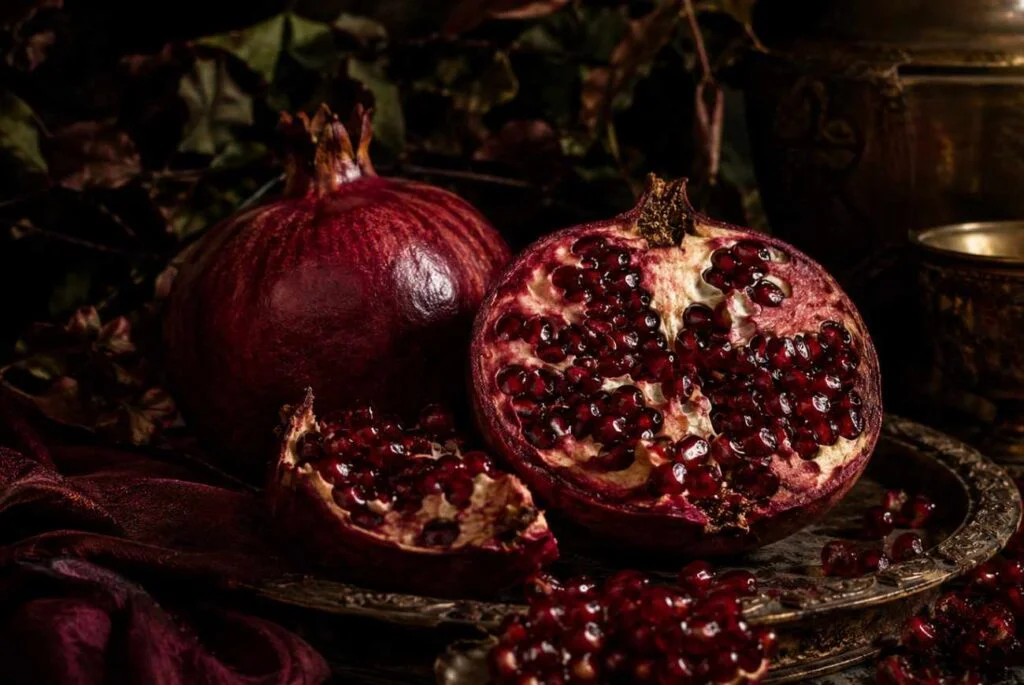
The fruit that holds the mysteries of life, death, and rebirth
There are symbols that traverse millennia without losing their power.
Objects, plants, images, or fruits that continue to live in the collective memory of humanity as eternal archetypes, capable of speaking directly to the unconscious, to spirituality, and to the oldest part of the soul.
The pomegranate is one of these.
It is not just a fruit.
It never has been.
Since ancient times, its presence has appeared in temples, myths, initiatory cults, funerary traditions, rituals dedicated to fertility, and even in sacred representations of feminine power. Its perfect shape, the resilient and almost regal skin, the deep red color of its seeds, resembling drops of living blood, have transformed the pomegranate into one of the most powerful esoteric symbols ever to exist.
To look at it means to observe a small hidden universe.
On the outside, it appears closed, protected, almost silent.
But it is by opening it that it reveals its mystery: hundreds of shining seeds, kept like secrets within a sacred womb. It is impossible not to grasp the symbolic call to fertility, to creation, to life multiplying, and to the ancestral strength of the feminine.
Yet the pomegranate does not only speak of birth.
It also speaks of descent.
Of transformation.
Of invisible worlds.
In Greek mythology, its fate is inevitably intertwined with that of Persephone, the young goddess abducted by Hades and taken to the Underworld. It is through the pomegranate that the myth takes on its deepest meaning. Persephone eats the seeds of the sacred fruit and, through that seemingly simple gesture, becomes forever bound to the underground realm. She no longer belongs solely to the light of spring but also to the darkness of the afterlife.
And it is here that the pomegranate ceases to be a symbol of mere fertility and becomes something immensely deeper: a bridge between life and death.
In ancient esotericism, indeed, the descent into the Underworld did not represent a punishment, but an initiation. To descend into the shadow meant to confront the deepest parts of oneself, to traverse inner chaos, to die symbolically in order to be reborn transformed. Persephone does not return from the Underworld identical to before: she emerges different, more complete, more powerful. Queen of both light and darkness.
And it is exactly this that the pomegranate holds within its seeds.
The knowledge that every authentic transformation requires a descent.
That every rebirth passes through a symbolic death.
That what breaks can become sacred.
For this reason, the pomegranate has appeared for centuries in spiritual traditions linked to feminine mysteries, earth cults, lunar deities, and initiatory practices. Its energy is profoundly magnetic, uterine, ancient. It does not possess the innocent sweetness of floral symbols: the pomegranate carries with it eros, blood, ancestral memory, and power.
In the Mediterranean, it was considered a sacred fruit capable of attracting prosperity, fertility, and protection. In many folk traditions, opening a pomegranate within the home represented an act of abundance and blessing. Its numerous and bright seeds embodied wealth, the continuity of lineage, the life that continues to regenerate despite time, losses, and death.
But behind this luminous symbolism, there always exists a darker and subtler one.
Many esoteric currents indeed connect the pomegranate to initiatory blood, the cosmic womb, and the mysteries of the incarnated soul. Some hermetic texts considered the fruit a symbolic representation of the universe itself: a multitude of souls enclosed in a single living body. Each seed then becomes a possibility, a karmic memory, a spiritual spark ready to germinate.
Even its internal structure recalls the alchemical concept of transformation: what appears hard and impenetrable on the outside holds within it the most precious matter. It is the same idea present in spiritual alchemy, where true gold does not arise from the surface but from an inner process of death and rebirth.
And perhaps it is precisely for this reason that the pomegranate continues to exert an almost hypnotic charm in the spiritual and occult world today.
There is something deeply primordial in it.
Something that speaks directly to the most instinctive and mysterious part of the human being.
In ritual practices, it is often used in works dedicated to prosperity, sacred sensuality, manifestation, and connection with deep feminine energy. Its dried peels are burned as offerings or included in protection rituals, while the seeds are associated with abundance, creative fertility, and the ability to attract what must grow in one’s life.
But its most powerful meaning perhaps remains the spiritual one.
The pomegranate reminds us that within every human being exist invisible worlds.
That true transformation does not occur on the surface, but in the depths.
That even darkness can become a womb of rebirth.
We live in an era that fears inner descent, that flees from silence, pain, and shadow. Yet ancient traditions taught exactly the opposite: it is by traversing the darkness that the soul regains its completeness.
The pomegranate carries this teaching for thousands of years.
It holds it in its seeds red as blood, in its almost regal beauty, in its sweet and earthy flavor, in the sacred memory that continues to survive through myths, rituals, and symbols.
Because some fruits nourish the body.
Others, however, seem to nourish the soul directly.
And the pomegranate has always belonged to the latter.