
The Ulam Spiral: A Dance of Numbers and Mysticism
Exploring the mystical dance of numbers within the Ulam Spiral, revealing hidden rhythms and the nature of prime numbers in the universe.
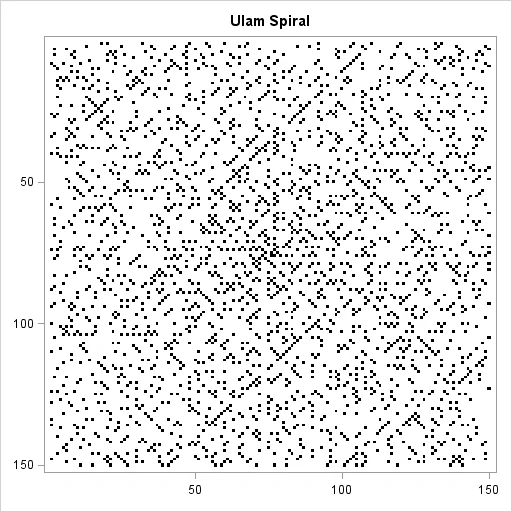
In the realm of mathematics, the Ulam Spiral reveals a profound rhythm, echoing the pulsations of the universe itself. The intricate lines of this spiral seem to resonate with something deeper, hinting at hidden vibrations that govern the numerical world.
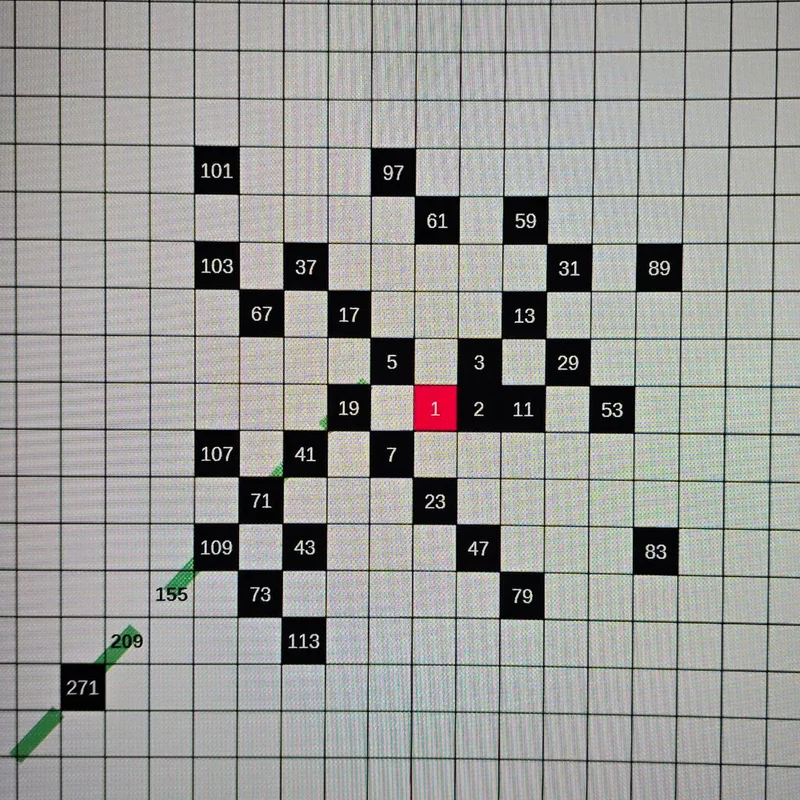
The diagonal line descending to the left, marked by a green dashed line, showcases a sequence that is both intriguing and enigmatic: 5, 19, 41, 71, 109. The underlying 'reason' behind this series is not immediately apparent; however, a closer examination reveals that the gaps between these numbers follow an arithmetic progression, increasing by 8 with each iteration:
- 19 - 5 = 14
- 41 - 19 = 22 (= 14 + 8)
- 71 - 41 = 30 (= 22 + 8)
- 109 - 71 = 38 (= 30 + 8)
This sequence evolves according to a polynomial rule, expressed as f(n) = 4n² + 2n - 1, which frequently yields prime numbers when x ranges from 1 to 5:
- (4 × 1²) + (2 × 1) - 1 = 5
- (4 × 2²) + (2 × 2) - 1 = 19
- (4 × 3²) + (2 × 3) - 1 = 41
- (4 × 4²) + (2 × 4) - 1 = 71
- (4 × 5²) + (2 × 5) - 1 = 109
However, starting from 6, the series halts in its prime-generating capacity. More precisely, while the function continues to produce numbers, they no longer remain exclusively prime.
The first forty numbers from this diagonal sequence—5, 19, 41, 71, 109—continue as follows: 5, 19, 41, 71, 109, 155, 209, 271, 341, 419, 505, 599, 701, 811, 929, 1055, 1189, 1331, 1481, 1639, 1805, 1979, 2161, 2351, 2549, 2755, 2969, 3191, 3421, 3659, 3905, 4159, 4421, 4691, 4969, 5255, 5549, 5851, 6161, 6479.
The ability of this diagonal sequence to produce prime numbers resembles a rhythmic pulse, surfacing intermittently like a dolphin breaking through the waves before diving back beneath the surface. There exists a discernible order, as the line is clearly identifiable and often generates remarkable sequences of four or five consecutive prime numbers. Yet, the underlying cause of these emergences and disappearances remains elusive; the tempo—or perhaps the rhythm—of this numerical melody is still a mystery.
What we observe are localized arrangements, pulsations, and fragments of lines within the grand diagonal, where, for reasons unknown, a semblance of structure appears to triumph over the surrounding chaos. It raises the question of whether there exists, hidden within higher dimensions, a polynomial function of degree z or an Ulam Spiral from another dimension that accounts for these phenomena, justifying the fluctuations within the mathematical universe. For now, this remains unknown. We can only perceive these islands of primality, strung together like an Aleutian necklace, slowly unraveling in the vast ocean of numbers, while we listen to the irregular heartbeat, akin to the tachycardia of the grand arithmetic pulse.
Something, somewhere, beats strongly, as the lines of the Ulam Spiral reveal echoes—or perhaps vibrations—of the cosmos.
To accompany this exploration, one might listen to Edvard Grieg's "In the Hall of the Mountain King," whose tempo (or perhaps rhythm?) accelerates, mirroring the diminishing frequency of prime numbers as one moves away from zero.
The cover image is sourced from the Android application "Ulam Spiral" by Tomoyuki Hoshi.