Unakite: The Reconciliation of Heart and Roots
Unakite embodies the reconciliation between heart and roots, symbolizing inner stability through the integration of diverse experiences. This metamorphic stone offers insights into emotional healing and personal growth.
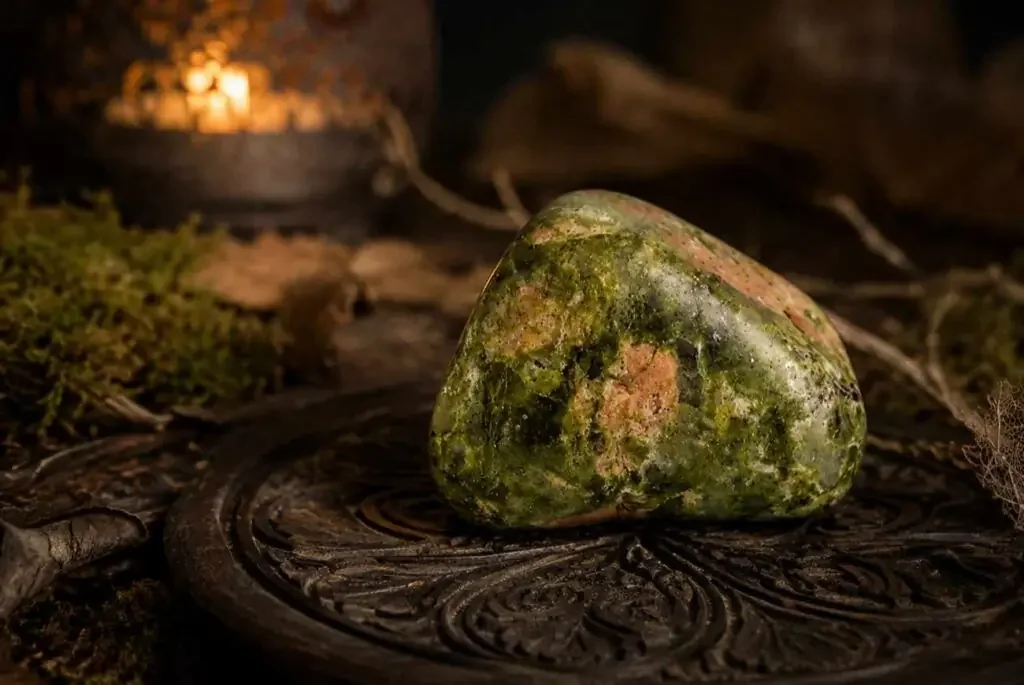
In the realm of crystal therapy, various stones captivate us with their brilliance, transparency, or vivid colors. Unakite, however, belongs to a more understated category: it does not dazzle through excess but rather through the harmony of its differences. Its surface, born from the interplay of green epidote, pink feldspar, and light quartz hues, visually narrates one of the qualities traditionally attributed to it: the ability to integrate diverse aspects of experience without forcing them to become identical.
Upon closer observation, unakite never appears perfectly uniform. Its tones intertwine irregularly, creating a natural mosaic where no single color completely dominates another. This imperfect balance renders it recognizable and symbolically significant. In an age that often seeks absolute coherence, constant performance, and continuous control, this stone evokes the notion that inner stability can emerge not from the elimination of contradictions, but from the capacity to coexist with different sensitivities within the same structure.
From a mineralogical perspective, unakite is not a single mineral but a metamorphic rock primarily composed of green epidote, pink orthoclase, and quartz. Its name derives from the Unaka Mountains, a range located between Tennessee and North Carolina in the United States, where it was first identified and described in the 19th century. Its formation results from complex geological processes: pre-existing rocks are transformed by pressure, temperature, and the circulation of mineral fluids, leading to a new stable structure.
This metamorphic origin carries profound symbolic value. Unakite arises from deep transformation: what existed before is not destroyed but reorganized into a different configuration. In the context of crystal therapy, this characteristic resonates with the concept of inner evolution through experience. Difficulties, intense emotions, and changes are not elements to be erased but parts of a process that can lead to greater personal integration.
The color combination of unakite significantly influences the energetic interpretations associated with it. Green is traditionally linked to the heart chakra, growth, emotional balance, and the ability to heal both inner and outer relationships. Pink, on the other hand, evokes sweetness, acceptance, self-compassion, and emotional openness. The convergence of these two colors has led many practitioners to regard unakite as a stone of emotional reconciliation, particularly suited for times when the heart needs to rediscover a more harmonious dialogue with its own history.
In crystal therapy, it is often associated with restoring the balance between emotion and grounding. This definition distinguishes it from stones perceived as solely calming or stimulating. Its energy is generally described as stable, progressive, and concrete: it does not push towards states of intense expansion but accompanies a slow process of inner reassembly.
Many individuals experience periods where the past silently yet persistently influences the present. Unprocessed experiences, concluded relationships, disappointments, unmet expectations, or phases of life left unresolved can create emotional fragmentation that is difficult to recognize. Traditionally, unakite is used as a symbolic support to foster greater awareness of these contents, helping to bring them to light without judgment and without the need for immediate resolution.
One of the most intriguing aspects attributed to unakite concerns its relationship with emotional memory. This is not memory in the sense of mere mental recall, but a deeper form through which the body and emotional system continue to react to past experiences even when the mind considers them concluded. In this perspective, unakite is seen as a stone capable of facilitating recognition and integration, allowing individuals to observe their wounds with greater clarity and less resistance.
This quality makes it particularly prevalent in introspection and personal growth practices. During meditation or moments of reflection, many use it to maintain a more stable connection with their emotions without being overwhelmed. The goal is not to relive the past but to understand how it may still influence current choices, relationships, and perceptions.
On an emotional level, unakite is often associated with the ability to embrace vulnerability. In many contemporary cultures, this condition is perceived as something to be avoided, a sign of fragility or loss of control. Crystal therapy tradition, however, offers a different interpretation: recognizing what one feels, even when uncomfortable or painful, represents an act of authenticity and inner strength. Unakite embodies this possibility, fostering a less defensive relationship with one’s emotional world.
For this reason, it is frequently linked to the healing processes of the heart after difficult emotional experiences. Not because it is believed to erase pain, but because it symbolically supports the transition from closure to gradual reopening. After disappointment, it is common to build emotional barriers to avoid further suffering; however, these same barriers can also limit the capacity to receive affection, trust, and connection. Thus, unakite is interpreted as a reminder: protecting oneself should not mean ceasing to feel.
Its energy is described as particularly beneficial during transitional periods. Job changes, relocations, new relationships, separations, family transformations, or phases of personal redefinition can generate a sense of uprooting. In these moments, the need for security often coexists with the necessity to evolve. Unakite, symbolically linking the heart to earthly grounding, is utilized to foster greater stability while opening up to change.
Another central aspect concerns the relationship with the body. Unlike stones predominantly associated with the mental or spiritual realm, unakite is often perceived as a very "earthy" presence. Its connection to the earth element emphasizes the importance of inhabiting the body, listening to its signals, and recognizing that inner well-being does not solely depend on thoughts but also on the quality of one’s relationship with their physical dimension.
Energetically, it is primarily linked to the heart chakra, but also to the root chakra. This dual association is significant: the heart represents emotional openness, while the root pertains to security, stability, and a sense of belonging. Unakite thus seems to bridge these two dimensions, reminding us that a truly open heart needs to feel sufficiently secure to express its authenticity.
In esoteric contexts, it is often associated with slow and natural growth. Unlike stones perceived as accelerators of sudden transformations, unakite is considered aligned with the gradual processes of nature: the growth of a plant, the ripening of fruit, the slow erosion of a mountain. This symbolism evokes the idea that the most profound changes rarely occur instantaneously; they require time, continuity, and a willingness to traverse often unremarkable intermediate phases that are nonetheless essential.
Particularly interesting is its symbolic relationship with self-compassion. We often find it easier to understand the difficulties of others than to apply the same kindness to ourselves. We judge ourselves for mistakes, fears, emotional reactions, or healing times that do not meet expectations. Unakite is traditionally associated with the possibility of developing a gentler perspective towards oneself, recognizing that personal growth is not a linear journey but a process filled with progress, pauses, and reworking.
Its aesthetic aspect seems to support this teaching. The green and pink zones are not separated by perfect boundaries; they blend, interrupt, and mix in unpredictable ways. This natural image can be interpreted as a metaphor for human identity. Within us coexist strength and sensitivity, stability and change, light and shadow. Maturity does not consist of becoming a single entity but in allowing these parts to converse without denying each other.
Its energy is generally perceived as soft yet transformative. It does not create the sensation of a sudden push; rather, it accompanies a slow process of inner sedimentation. It is the type of change that is often only recognized in hindsight: one notices reacting with less rigidity, listening more attentively, and feeling less at war with one’s own history.
In this perspective, unakite represents much more than a stone associated with the heart. It becomes a symbol of reconciliation between who we have been and who we are becoming, between roots and evolution. It reminds us that authentic growth does not require erasing the past but integrating it into a new and more conscious form. Like the metamorphic rock from which it originates, a human being can transform without losing their essence.
Its deepest teaching seems to be this: true healing does not consist of becoming perfect but in allowing fragmented parts to rediscover a common balance. When heart and roots resume their dialogue, change ceases to be an escape from what we were and becomes a more authentic return to what we can be.