Beyond Light and Shadow: The Syncretic Mystery of Saint Cyprian
The Syncretic Mystery of Saint Cyprian explores the enigmatic figure who embodies the intersection of spirituality, magic, and faith, revealing the profound connections between light and shadow.
The Syncretic Mystery of Saint Cyprian
There are spiritual figures that transcend time without ever truly dissolving, names that continue to live not only in religion or folklore but directly in the collective unconscious of humanity. Saint Cyprian belongs to this rare and magnetic category. His figure eludes any simple definition, as he exists suspended between saint and magician, between mystic and initiate, between faith and mystery. Over the centuries, his name has been spoken in monasteries, grimoires, rural villages, popular rituals, and esoteric practices passed down in whispers. For some, he is a Christian martyr; for others, a powerful occultist turned convert; for others still, the guardian of invisible thresholds and spiritual forces. It is precisely this ambivalence that has made Saint Cyprian one of the most enigmatic and fascinating figures in the entire Western esoteric tradition.
His origins intertwine history, legend, and symbolism. According to the most widespread tradition, Cyprian was born in Antioch between the 3rd and 4th centuries AD, at a time when religion, astrology, philosophy, and mystical practices coexisted in the same cultural universe. Legends tell that he was initiated from a young age into the esoteric arts and the knowledge preserved in the temples of the ancient East. This was not the “magic” of modern times understood in a superficial sense, but that ancient spiritual knowledge which encompassed sacred astrology, ritual evocation, study of symbols, theurgical practices, and understanding of the invisible forces of nature.
According to esoteric folklore, Cyprian traveled through Greece, Egypt, and Babylon to learn the deepest initiatory disciplines, becoming a man feared and respected for his knowledge. In the ancient world, indeed, spiritual knowledge was considered power. Those who understood the invisible languages of reality were viewed with awe, for mystery has always exerted an irresistible force over humanity.
The central moment of his legend arrives with the encounter with Justina, a young Christian devoted to her faith. According to the traditional account, a man in love with the woman asked Cyprian to use his arts to make her yield emotionally. Cyprian then evoked spiritual forces and performed rituals to influence her, but every attempt failed. Justina's faith broke any influence evoked against her.
This episode possesses a profound symbolic significance. It does not merely represent the conflict between religion and magic, but the confrontation between two forms of power: that of control and that of spiritual consciousness. The legend tells that this very event led Cyprian to understand the existence of a higher force than the one he had pursued all his life. He thus decided to abandon the occult arts, convert to Christianity, and ultimately become a bishop and martyr.
Yet his past was never erased.
And it is here that the true mystery of Saint Cyprian is born. Unlike other saints, in fact, his image was never completely separated from the world of the occult. In popular devotion, especially in Spain, Portugal, and Latin America, he continued to be perceived as one who knew both paths: light and shadow, the sacred and the invisible power, faith and mystery.
This vision transformed him into the saint of thresholds, the guardian of spiritual passages and invisible energies. The people began to see him as a figure capable of understanding dark forces precisely because he had traversed them. And this is one of the most important aspects to understand why, even today, many people choose to work ritualistically with him.
In the esoteric world and in popular spirituality, Saint Cyprian is often regarded as a protector against negativity, a spiritual intermediary, and a presence linked to inner transformation. People choose to work with him not only for protection but primarily because his symbolic energy is associated with the ability to navigate crises, dissolve energetic blocks, and confront personal shadows without being dominated by them.
Saint Cyprian embodies the archetype of the initiate who has known power but also the burden of that power. For this reason, in popular traditions, he is invoked during moments of transition, phases of rupture, radical changes, and periods when a person feels the need to reclaim spiritual strength, protection, and inner clarity.
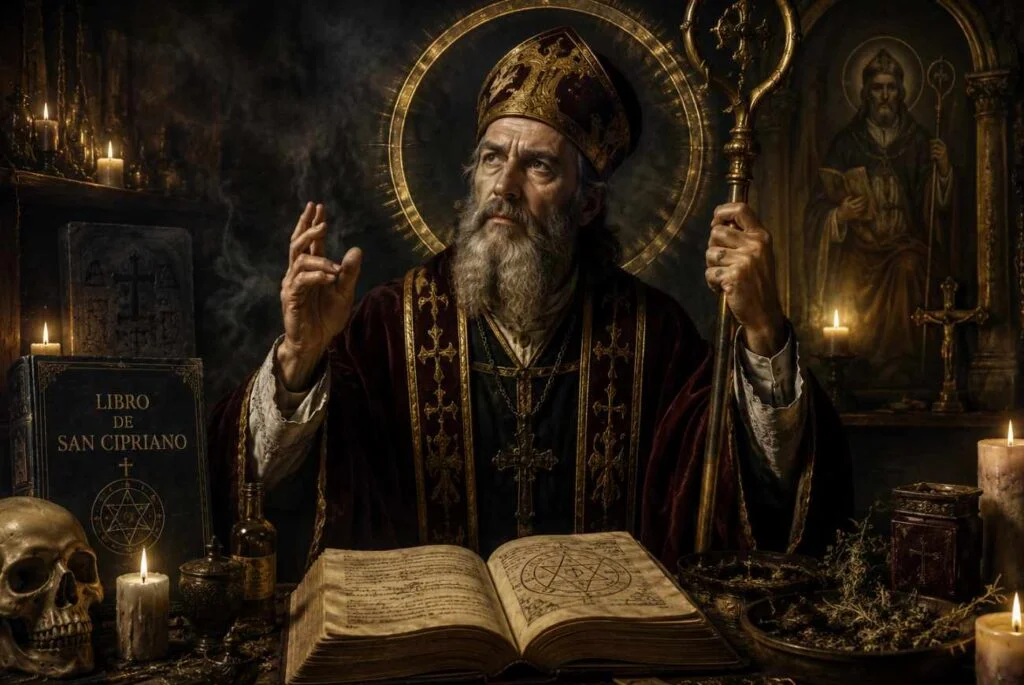
Many rituals dedicated to Saint Cyprian indeed arise with the purpose of spiritual defense, energetic purification, opening paths, and protection against influences considered heavy or negative. In popular ritualism, elements such as candles, psalms, blessed water, protective herbs, and ritual prayers are used. However, authentic esoteric tradition has never regarded ritual as a mere mechanical formula. Ritual was a symbolic language, an act of will and consciousness capable of connecting the human being with the sacred and their inner world.
Working spiritually with a figure like Saint Cyprian thus means confronting the concept of energetic responsibility. It means understanding that spiritual knowledge cannot exist without discipline, balance, and awareness. And it is precisely this that distinguishes authentic spirituality from superficial superstition.
One of the elements that has greatly contributed to the fame of Saint Cyprian is undoubtedly the famous Book of Saint Cyprian, also known as The Treasure of the Magician. This grimoire, surrounded for centuries by fear and legend, collects ritual formulas, symbols, prayers, protective practices, and popular traditions from the Iberian and Latin American worlds. Over time, many different versions have emerged, often contaminated by popular Christianity, medieval occultism, rural folklore, and hermetic symbolism.
And it is precisely this fusion that makes it culturally so important. The Book of Saint Cyprian represents one of the greatest examples of Western spiritual syncretism, a meeting point between official religion, popular practices, and esotericism.
In Brazil, the figure of Saint Cyprian has taken on an even broader and more complex dimension over time, deeply entering the syncretic spiritual traditions of Umbanda and Quimbanda. In these contexts, his name is often associated with the knowledge of spiritual forces, energetic protection, and the ritualistic opening or defense. The Book of Saint Cyprian has become, especially in Brazilian popular culture, one of the most well-known and controversial grimoires. It is not seen merely as an esoteric text but as a sort of bridge between the spiritual world and the material one. Many versions circulated in Latin America indeed contain elements from popular Catholicism, Iberian magic, spiritual practices, and Afro-Brazilian traditions.
In Umbanda, the name of Saint Cyprian is sometimes associated with spiritual protection and the knowledge of invisible energies. In Quimbanda, however, his figure often takes on a more liminal and mysterious aura, linked to the mastery of spiritual forces and the understanding of inner shadows. It is important to remember that much of these traditions belongs to popular spirituality and syncretic folklore, where religion, magic, and culture merge in an extremely profound way. And it is precisely this fusion that makes Saint Cyprian a unique figure in the history of Western esotericism.
A vast folklore also developed around his figure. In some regions of Portugal, it was said that his book should be kept covered with a black cloth. In Spain, it was passed down that certain formulas should not be read after sunset. In Brazil, his name is still deeply linked to popular ritualism and syncretic spiritual traditions. Beyond the historical veracity of these tales, what truly matters is their symbolic value. They show how deeply Saint Cyprian has become the very face of spiritual mystery in the West.
His figure continues to fascinate because it speaks of something that humanity has never ceased to seek: the relationship with the invisible. His story narrates the desire to understand what lies beyond matter, beyond fear, and beyond the ordinary limits of consciousness.
Saint Cyprian embodies the human journey into power, transformation, and mystery. He is the symbol of one who traverses the shadow without denying its existence, understanding that every spiritual knowledge carries with it responsibility and consequences.
For Saint Cyprian is not just a saint. He is a threshold. And every threshold always guards a mystery.
Ritual Focus — Traditional Prayer of Protection to Saint Cyprian
Among the most widespread devotional practices related to Saint Cyprian are prayers of protection, used in popular spirituality as a form of request for defense, inner strength, and the warding off of negativity. One of the most well-known traditional formulas reads:
“Glorious Saint Cyprian,
you who knew the visible and invisible mysteries,
protect my path from all evil and darkness.
Ward off heavy energies,
guard my home, my spirit, and my mind.
Let no negativity cross my threshold
and may the light of divine protection accompany every step I take.
So be it.”
In popular tradition, this prayer is often accompanied by the lighting of a white candle and a moment of spiritual reflection, symbolizing purification, clarity, and energetic protection.