The Esoteric World: An Endless Universe
What is esotericism? An exploration of its vastness beyond superficial practices, delving into symbols, spirituality, and the quest for hidden knowledge.
What is esotericism really?
It is a question as ancient as humanity itself.
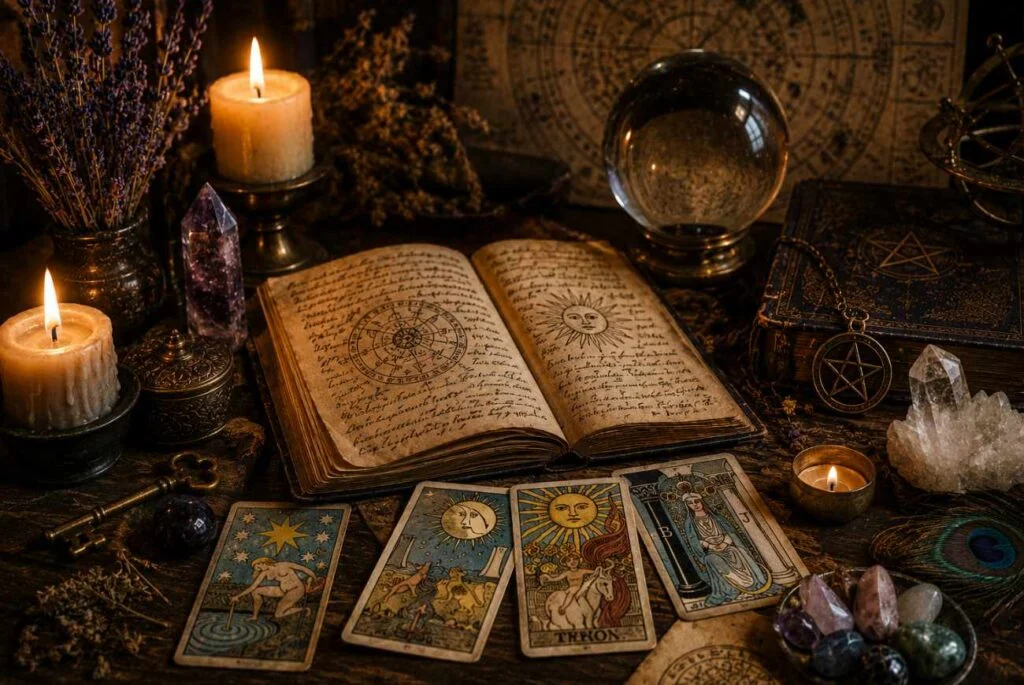
A question that traverses centuries, cultures, forgotten temples, hidden libraries, folk traditions, and inner paths. Yet, even today, when esotericism is mentioned, many people only imagine tarot cards, candles, moons, and rituals.
But that is merely the threshold.
The true esoteric world is immensely broader. It is an intertwining of symbols, spirituality, philosophy, energies, psychology, magic, introspection, and the quest for hidden knowledge. An universe built on the idea that there exists something beyond the visible surface of reality.
The word "esoteric" derives from the Greek esôterikos, meaning "interior," "reserved," "hidden from those who do not truly seek." And perhaps this is where the authentic heart of esotericism lies: not a trend, not an aesthetic, not a mere ritual practice, but a path of deep understanding of the human being and the invisible forces that permeate existence.
Since ancient times, humanity has sought to communicate with what could not be rationally explained. The stars, fire, dreams, death, spirits, the cycles of nature, recurring symbols in visions and the unconscious: everything was observed as part of a sacred language of the universe.
For this reason, esotericism has never been a singular entity.
Within its vast panorama coexist divinatory practices, astrology, alchemy, rituals, ancestral cults, meditation, folk magic, study of symbols, initiatory traditions, and spiritual paths. Each culture has developed its own way of interpreting the relationship between the visible and the invisible.
Divination, for example, is one of the oldest and most widespread practices. Tarot cards, runes, sibyls, pendulums, palmistry, dream interpretation, mirrors, water, fire, wax, or bones do not simply arise to "predict the future," as is often superficially believed. In traditional esoteric vision, these tools primarily served to read energies, understand inner blocks, identify possibilities, and observe deep directions and dynamics of existence.
Human beings have always sought signs.
And from this quest also arises ritual magic.
Long before modern spirituality and social networks, there existed rituals for protection, purification, healing, prosperity, opening paths, and spiritual connection. Nothing was considered random: the color of a candle, the type of herb used, the lunar phase, the time of the ritual, the engraved symbol, the day of the week. Each element possessed a precise energetic meaning.
For ancient traditions, in fact, the universe was alive.
Everything was connected.
The lunar phases, for example, were considered manifestations of different energies: the New Moon associated with beginnings and the sowing of intentions; the Waxing Moon with growth and attraction; the Full Moon with energetic expansion; the Waning Moon with release, closure, and purification.
Even the planets held symbolic and spiritual functions. The Sun represented vital force and identity, the Moon intuition and the unconscious, Mars action and the fire of will, Venus love and harmony, Mercury the mind and communication, Jupiter expansion and prosperity, Saturn karma, time, and the profound lessons of existence.
From here arise the ancient esoteric correspondences: planetary days, planetary hours, astrological alignments, equinoxes, solstices, and celestial events observed as movements capable of influencing collective and inner energies.
But true esotericism, the authentic kind, should never transform into obsession or fear.
Today, many people find themselves trapped in the idea that everything depends on retrograde Mercury, the "wrong" moon, or the energy of the moment. Yet spirituality should not take away mental freedom, but rather expand it. Energies can accompany a path, but personal will, clarity, personal responsibility, and concrete actions remain fundamental.
One of the most fascinating aspects of the esoteric world is its symbolic language.
Esotericism speaks through archetypal images that have traversed humanity for millennia: serpents, keys, spirals, mirrors, seals, ancient crosses, pentacles, eyes, moons, and labyrinths. Nothing arises by chance. Each symbol contains layered meanings that speak to both consciousness and the unconscious.
Not surprisingly, Carl Gustav Jung himself studied the power of archetypes, the inner shadow, dreams, and universal symbols deeply. Many aspects of esotericism directly touch upon the deep psychology of the human being, showing how mystery does not only belong to the supernatural but also to the most invisible areas of the mind.
And speaking of the invisible, we enter one of the most controversial themes: energetic protection.
Almost all spiritual traditions around the world speak of negative influences, heavy energies, the evil eye, astral larvae, energetic vampirism, or spiritual impurities. Hence the use of incense, salt, herbs, stones, amulets, and protective symbols. Beyond personal beliefs, what clearly emerges is the human need to protect one’s inner and energetic space.
Because the esoteric world is not made solely of "light."
There are also deep shadows: spiritual manipulation, mystical ego, dependence on rituals, fanaticism, false promises, and people who exploit the fragility of others in the name of spirituality. This is why the true esoteric path requires study, balance, discernment, and critical spirit.
Authentic esotericism does not invite one to flee from reality.
It invites one to understand it more deeply.
And perhaps this is the point that is most often forgotten in modern spirituality transformed into aesthetics. Today, symbols, moons, crystals, and tarot cards are often used as visual trends, emptied of their original meaning. But the true esoteric path is anything but superficial.
It is an inner journey.
Sometimes uncomfortable.
Sometimes destabilizing.
Because it forces the human being to look within themselves without masks.
Alchemy, for example, was not just about the transformation of lead into material gold. The true gold was the spiritual transformation of the human being: the transmutation of consciousness, fears, the shadow, and inner matter.
The concept of death also takes on different meanings in esoteric traditions. In many cultures, death does not represent an absolute end, but a passage, a metamorphosis, a rebirth. From here arises the cult of ancestors, the relationship with spirits, the theme of astral planes, reincarnation, and the invisible world.
After all, the esoteric world has existed since humanity has existed.
Before modern religions, there already existed lunar cults, solar cults, shamanism, druidism, folk magic, and ancestral practices that considered nature a sacred and living force.
And perhaps the reason why esotericism continues to fascinate even today is precisely this: it speaks of what humanity has never truly stopped seeking.
The mystery.
The hidden meaning of things.
The connection with something greater.
The inner transformation.
The understanding of oneself.
Because true esotericism does not consist of possessing absolute answers.
It consists of continuing to seek.
And it is precisely there, among ancient symbols, intuitions, shadows, knowledge, and consciousness, that an endless universe opens up.