The Magic of Kālī, the Black Goddess
The Magic of Kālī, the Black Goddess. Practicing the worship of Kālī is an initiation into the inner fire, guiding the modern Witch towards a truth that devours as much as it illuminates.
The Magic of Kālī, the Black Goddess
Practicing the worship of Kālī is not a path of comfort, but an initiation into the inner fire. It is a practice that demands the sacred fire to burn and purify the constructed identity, guiding the modern Witch towards a truth that devours as much as it illuminates.
Approaching this magic means understanding that destruction is not the end, but the necessary condition for vital energy to be freed from the forms that have imprisoned it.
This path is not a power game, but an act of radical surrender. When a Witch or a Tantrika invokes Kālī, they are not calling upon an entity to fulfill a worldly desire, but invoking the inner sacred fire that dissolves every limit, accelerating the fulfillment of their destiny.
Encountering her energy requires the courage to look into the abyss without averting one’s gaze and without trembling, for her energy knows no compromises. It is the path that leads beyond the cages of identity, abandoning the fragile certainties of the self to open up to the vastness of the cosmic void.
The Difference Between Tantra and Tantrika
Those who choose this path do not seek a life without conflicts, but the mastery necessary to transform every conflict into a step towards their ultimate liberation. Such mastery requires a clear understanding of the path, for one cannot invoke Kālī without being able to distinguish the vision of Tantra from the operationality of the Tantrika.
In the contemporary esoteric landscape, the terms Tantra and Tantrika are often used synonymously, creating confusion that can limit a deep understanding of these disciplines.
If Tantra is the worldview and the understanding that everything is divine energy and that there is no separation between sacred and profane, the Tantrika is the one who acts on this awareness to transmute reality. If Tantra is the wisdom of knowing that we are made of stars and abysses, the Tantrika is the art of mastering that material to cease being slaves to fate and finally become masters of their own path.
Darkness, taboos, and shadows are not obstacles to avoid, but raw material to transmute and at the same time the fuel that powers their ascent. The Tantrika is like an alchemist who takes what is raw (anger, fear, traumas, impulses) and, through the fire of their will and the invocation of deities, transforms it into Tejas, the sacred fire that is nothing but pure energy that accelerates spiritual evolution.
This is the fundamental difference compared to many other magical paths. In common devotional magic, one addresses an external deity to ask for a favor. In Tantrika, you do not call Kālī to give you something: you become Kālī.
Through identification with the archetype, you recognize that force, the Shakti, is already within you, dormant at the base of the spine as Kundalini. The Tantrika is the process that awakens this force and directs it with surgical precision to sever the karmic knots and illusions that keep you bound.
The term Tantra derives from the Sanskrit roots tan (to expand) and tra (instrument). Understanding Tantra means having a gaze that sees the immanent divinity in every aspect of reality. It is the map of the territory, the theoretical place where the unity of existence is recognized. In Tantra, the distinction between sacred and profane dissolves: everything that exists is an expansion of Consciousness (Shiva) and Energy (Shakti).
The Tantrika, on the other hand, is the Path of Operational Fire. In this discipline, the letter "K" emphasizes operationality. A mystical decomposition is often used to explain its nature: as seen, tan invokes the expansion and weaving of the cosmic fabric, while trika in Sanskrit means "triple." The Tantrika is therefore the art of being (tan) the triad (trika) of Consciousness, Energy, and Individual in a single act of will. When you invoke Kālī, you are not merely performing a rite; you are harmonizing your inner triad: severing illusions (Shiva observing), activating the fire (Shakti acting), and transforming your identity (Jiva evolving).
If Tantra is the map, the Tantrika is the path walked with the sword in hand. It is magic in action.
For those operating in modern esotericism, distinguishing these two aspects is a matter of integrity. Imagine the Ocean and the Navigator: Tantra is the Ocean, the vastness of awareness in which everything is one, while the Tantrika is the Navigator, who, knowing the nature of that ocean, uses their will as a rudder to steer the course. Studying Tantra without practicing Tantrika is like reading a navigation treatise without ever boarding a boat: one knows the theory but lacks the experience of the sea. Conversely, practicing Tantrika without understanding the philosophy of Tantra is like steering a ship in a storm without a map: one risks being overwhelmed by the very energy they seek to manipulate.
The Tantrika requires ethics, centering, and a deep awareness of their egoic self, for the magic operated through this path is powerful and immediate. It is a magic that does not ask for favors but activates the intrinsic laws of the universe to dissolve the illusions that keep us imprisoned.
Who is Kālī
Kālī is one of the most enigmatic and powerful deities in the Hindu pantheon. Her name is intrinsically linked to Kala, a Sanskrit word that means both "time" understood as an unstoppable force that devours everything, and "black," the color that absorbs all others. She is the personification of becoming, the relentless force that guides every being from birth to death and, ultimately, to rebirth.
If to the profane she appears as a terrifying image, to the wise, Kālī is not an evil goddess, but the Mother (Ma) who destroys false perceptions, liberating from the pain of attachment to what is ephemeral. She dissolves the old, the illusory, and the ego to allow for transformation; her destruction is, in fact, an act of purification necessary for renewal.
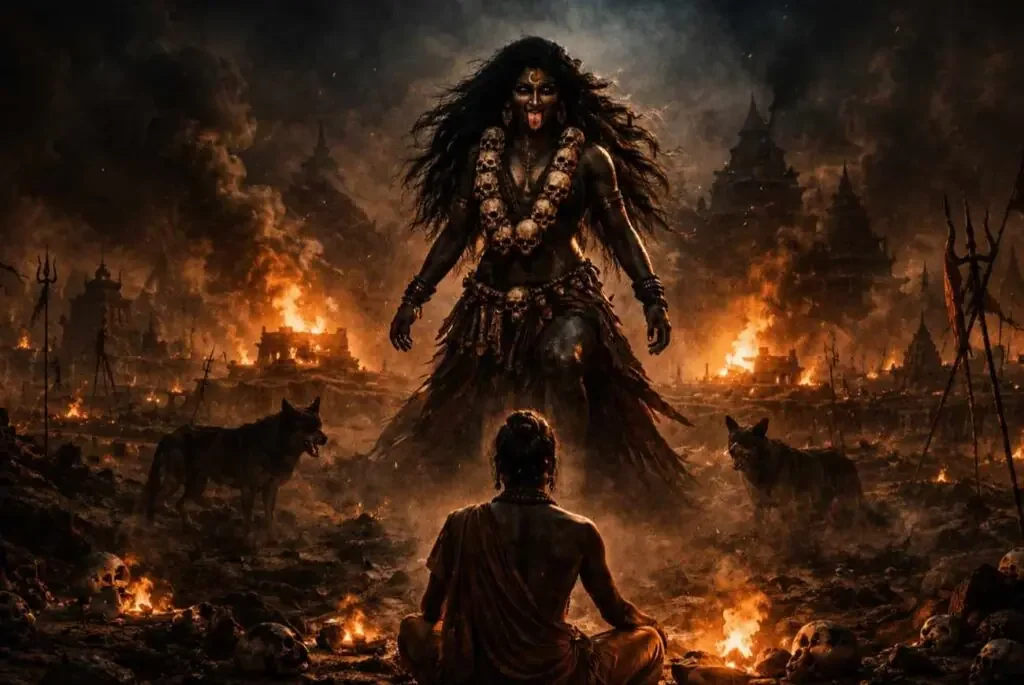
Often depicted with dark blue or black skin like the cosmic void, a garland of severed heads around her neck, and a belt of severed arms, her iconography constitutes a profound sacred language for the initiate.
Every element of her fearsome aspect possesses a precise metaphysical meaning: the heads represent the ego and the illusions that must be severed for the mind to be liberated, while the black-blue skin embodies the infinite, the primordial darkness from which everything arises and into which everything returns. Her nudity symbolizes being without veils, free from every illusion (Maya) and earthly convention.
The necklace of skulls and the skirt of arms represent the ego and human actions that the Goddess "cuts" to dissolve karmic bonds. The protruding tongue, often interpreted as a gesture of anger, actually symbolizes absolute control over passionate nature. Finally, the sword she wields is not a sign of gratuitous violence, but of divine Knowledge that severs ignorance.
At the same time, Kālī is the source of all creation and the supreme form of divine feminine energy: the Shakti. She is often depicted in close connection with Shiva: in many icons, she dances above his motionless body. Shiva represents pure and immutable Consciousness, while Kālī embodies dynamic energy, the very action that animates the universe.
Kālī, the First Mahāvidyā
In Hindu worship, Kālī is the first of the Mahāvidyā, the ten Great Goddesses of Tantric Wisdom that guide the practitioner towards spiritual liberation (Moksha). These are not merely deities to be worshipped, but stages of consciousness, cosmic forces, and operational archetypes that lead through the complex nuances of illusion and reality.
Kālī, the Black Goddess, sits at the pinnacle of this pantheon. Being the first of the Mahāvidyā, she is the foundation from which all others emanate. Kālī is the "Great Knowledge" that annihilates the ego: while the other Goddesses guide through specific aspects of existence such as beauty, speech, wealth, or stability, Kālī acts at the root. She is the supreme wisdom that teaches the ephemeral nature of every form.
The magic of Kālī as Mahāvidyā does not consist in accumulation, but in stripping away. She is the Seer who, through her eye as black as the infinite, observes our mental constructions and dissolves them. For the Tantrika, invoking Kālī in this capacity means asking for the grace of clear vision and, above all, the ability to tear the veil of Māyā to understand that destruction is the highest act of love that the universe can perform towards our soul.
What is Shakti
One cannot reach Kālī without understanding the nature of Shakti. Reality is composed of two eternal principles: Shiva, pure Consciousness, static and immutable witness, and Shakti, dynamic Energy, the creative power that shapes the universe.
Shakti is the vital spark that animates everything: it is the breath in the lungs, the pulse in the blood, the desire in the heart. When this energy remains dispersed in mundane activities, we are subject to the limits of karma and ego. However, when Shakti is awakened and directed inward, a process known as Kundalini Yoga, the energy rises up the spine, burning every energetic and psychic blockage along its path.
In the human body, this power lies dormant at the base of the spine as Kundalini. In this context, Kālī represents Shakti, energy that does not simply create to accumulate, but destroys what is obsolete to allow life to flow again.
Kālī is thus the supreme expression of Shakti in action. She embodies a disruptive force, necessary to break down outdated structures. Working with the energy of Kālī means learning to channel this primordial power to transcend one’s limits, allowing consciousness to expand beyond the confines of the small "I" and reconnect with the Infinite.
The Power of the Shakti of the Mahāvidyā
There is a magical power in the Shakti of the Mahāvidyā. Working with the Shakti of the Mahāvidyā means mastering the technology of energy. Shakti is not a static power, but a kinetic flow, a disruptive force that, if correctly directed through the operationality of the Tantrika, radically transforms the practitioner.
Each Mahāvidyā acts as a specific energy channel through which consciousness manifests. Together, they form a complete system of inner evolution:
- Kālī: Time and destruction that prepare the ground, breaking down every obstacle.
- Tārā: The guide that allows navigation beyond the ocean of Saṃsāra, offering protection and direction.
- Tripura Sundarī: The source of harmony, supreme beauty, and divine joy that shines in matter.
- Bhuvaneshvarī: The Lady of Space, who teaches us to expand consciousness to contain the entire universe within us.
- Bhairavī: The sacred fire that devours the remnants of past karma, infusing the warmth necessary for spiritual evolution.
- Chinnamastā: The Goddess who severs her own head, symbolizing the radical sacrifice of the ego to achieve immediate non-dual vision.
- Dhūmāvatī: The Goddess of the Void and the invisible; she teaches the wisdom that arises when everything is taken away, in the desert of renunciation.
- Bāgalamukhī: She who paralyzes illusions, mental chatter, and every false truth that hinders the path.
- Mātangī: The Goddess of speech and the arts, who transforms intellectual knowledge into vibrant and conscious expression.
- Kamalātmikā: The fullness of manifestation, recognizing divinity in the material world and bringing abundance and completeness.
The magic operated through the Shakti of the Mahāvidyā is not based on supplication rituals, but on rituals of identification. The practitioner...