Crystal Messages – The Earth Speaks Through the Mineral in Simone Bonucci's Book
Today I would like to talk about a moment, even before the stone is named, when the Earth ceases to be a floor and regains its original place. It is no longer the backdrop against which we walk distractedly, nor the mute reservoir from which we extract shapes, colors, objects.
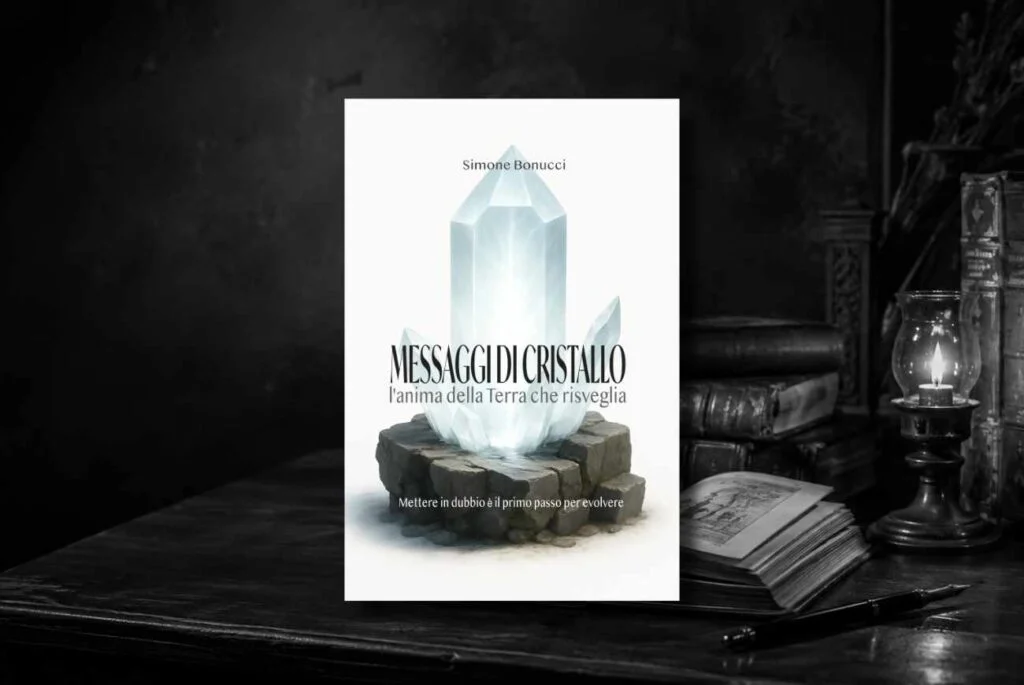
Today I would like to talk about a moment, even before the stone is named, when the Earth ceases to be a floor and regains its original place. It is no longer the backdrop against which we walk distractedly, nor the mute reservoir from which we extract shapes, colors, objects, ornaments to place on a bedside table or wear around our necks with a vague sense of protection. In Crystal Messages, Simone Bonucci starts exactly from this shift: not from the crystal as an object, but from the Earth as a presence. And already here the book shows its deepest intention. It does not aim to teach the reader to "use" stones, or at least not in the poor and functional sense that is too often attributed to every subtle practice today. It seeks to restore a relationship.
The subtitle, The Soul of the Earth that Awakens, is not an ornamental formula. It is almost a key to reading the entire volume. Bonucci does not treat the crystal as a spiritual accessory, does not reduce it to a good luck charm, does not describe it as a small magical device to be loaded with expectations and consulted on difficult days. Rather, he presents it as a form of language. A slow, mineral language, devoid of emphasis, that does not speak through words but through structure, coherence, weight, temperature, geometry, presence. The crystal is matter that preserves a memory. Not a narrative memory, not a memory in the human sense of the term, but a trace of order: the way in which the Earth, through millions of years of pressure, heat, fluids, fractures, and sedimentation, has found a stable form in which to express itself.
This is perhaps the first quality of the book: it removes crystal therapy from two opposing misunderstandings. On one side, the trivial superstition that transforms every stone into a handbook of immediate effects; on the other, the skeptical reductionism that sees the crystal only as a piece of matter devoid of relationship with those who touch it. Bonucci follows a third path, subtler and more difficult: the crystal does not do something "in our place," does not produce miracles, does not correct life like a technician called to repair a malfunction. The crystal resonates with something. And that something is not alien to the human being, because the human being belongs to the same Earth from which the mineral comes.
The preface is already a small initiatory declaration. The author recounts that it was not the crystal that called him first, but the Earth itself, through medicinal plants, leaves, essential oils, that green that is not just botany but a pedagogy of sensitivity. Only later does the mineral arrive, more essential, more ancient, less mobile than the plant, yet endowed with an even more concentrated transmission. The transition is important: plants and crystals are not two separate compartments of the holistic world, but two modalities through which the Earth educates listening. Plants introduce us to living transformation, breath, cyclicality. Crystals lead us towards permanence, structure, ordered density. Where the plant teaches growth and metamorphosis, the mineral teaches presence.
The book does not ask the reader to believe. This point is crucial. Bonucci insists several times on a different disposition: not to believe, but to listen. Blind faith is not required; indeed, it would almost be a hindrance if it became automatism or suggestion. What is asked for is more arduous: to stop long enough to perceive. It is a form of perceptive humility. Not moral humility, that somewhat theatrical one of those who pretend to lower themselves to be considered spiritual, but the natural humility of one who recognizes that they are not the only center of reality. In this sense, the crystal becomes a teacher because it does not argue, does not persuade, does not seduce. It simply is. And in its being, it also obliges us to verify how incapable we are of simply being.
The structure of the volume is clear and progressive. After the preface and introduction, the journey opens with the crystal as a channel of reality, then with geology understood as the unconscious magical act of the Earth, then with the human field as a receptive instrument, contact, the crystal that chooses the practitioner, purification and recharging, the energetic care of the home, the relationship with the physical body and emotional body, the chakras, and finally integration into daily life without dependency. The index clearly shows that the text is not a simple collection of properties of stones, but a journey: from the vision of the mineral to practice, from practice to the body, from the body to living space, from space to daily life.
The first chapter contains one of the central insights of the work: when we take a stone in our hand, we do not take an object, we enter into a relationship. This sentence may seem poetic, but in the context of the book, it takes on operational value. It changes the question. No longer: "What does this crystal do for me?" but: "What opens up in me when I come into contact with this mineral form?" It is a huge difference. In the first case, the stone is loaded with an external, almost servile task. In the second, it becomes a mirror, a conductor, an opportunity for tuning. The crystal, according to Bonucci, does not add qualities that we do not possess. It reactivates passages. It restores order where the mind has produced noise, where the body has accumulated contraction, where experience has created a subtle fracture.
This approach saves the book from a very common drift in the dissemination of crystals: the mechanical catalog. Naturally, stones have correspondences, traditions, associated qualities, and the text does not ignore them. But Bonucci seems to distrust the reduction of the crystal to a dictionary. If amethyst "serves" one thing, rose quartz another, and black tourmaline yet another, the risk is that the reader stops encountering the stone and begins only to apply labels. Here, however, the relationship is more alive. A stone can call, repel, quiet, bring to the surface, support, not because the manual has established it once and for all, but because the human field at that moment responds to that specific mineral quality.
Very beautiful, and among the most original passages of the book, is the chapter dedicated to geology. Bonucci performs an interesting operation: he restores to geology a sacred dignity without denying its concreteness. The Earth is not presented as a corpse to be dissected, but as an organism that writes in matter. The veins of quartz, geological chambers, druses, geodes, pressures, and crystallizations become the way in which the planet constructs memory. It is not about abandoning science to replace it with fantasy, but about seeing in the geological data also a symbolic significance. Crystallization, in this perspective, is order that arises from chaos, peace solidified after a long negotiation between temperature, pressure, time, and substance.
It is here that the title of the chapter, The Mineral Blood of the Planet, shows all its effectiveness. Hydrothermal fluids, veins of silica, the deep movements of the Earth are described as an internal circulation, not as a cold and distant process. The earthly matter becomes almost a body that processes, pushes, coagulates, deposits. The geode is even likened to a mineral placenta: a strong image, perhaps bold, but consistent with the vision of the book. The crystal does not arise from staticity; it arises from gestation. It is not an ornament of the world, but the result of a long labor. This allows the reader to look at the stone not as a finished thing, but as a condensed event.
The strength of the book lies precisely in this ability to change perspective. After a few pages, even the reader most accustomed to thinking of crystals as tools to "choose" or "clean" finds themselves taken elsewhere. The crystal is no longer the small object on the table. It is a fragment of deep time, a portion of Earth that has undergone processes almost unimaginable for our accelerated minds. The author often contrasts this geological slowness with modern speed. We want an effect, a signal, proof immediately. The crystal, on the other hand, teaches by subtraction. It does not raise the volume. It lowers ours.
The third and fourth chapters bring the discourse into the body. Here Bonucci introduces an element that makes the text more interesting than many generically spiritual works: the relationship between crystal and nervous system. Contact with the stone is not described merely as an "energetic" experience in the vague sense of the term, but as a modulation of bodily perception. The body, when it ceases to be defensive, can recognize more coherent fields. The crystal does not obligate, does not push, does not impose; it offers a form of order with which the human system can attune. For this reason, the true effort is not to feel, but to remove what prevents feeling.
This passage is precious because it brings practice back to presence. There is no need to multiply rituals, formulas, solemn gestures. It is necessary to create a condition of permeability. Contact, in the book, is not artificially constructed; it is liberated from obstacles. Expectation, haste, the will to obtain, fear of not feeling anything, need for confirmation: these are the true interferences. The crystal speaks, if we want to use this verb, when the human being ceases to overlap with the encounter. And the language of the stone is not necessarily spectacular. It can be a breath that descends, a jaw that softens, a weight that shifts, a barely perceptible stillness in the chest. Our culture, hungry for flashy phenomena, tends not to respect these micro-variations. Bonucci instead considers them the very heart of the experience.
From this also derives a small ethics of contact. It is not about dominating the stone, nor making it "work" as if it were a tool subjected to our will. It is about disposition. The book is permeated by a subtle yet constant critique of the predatory attitude of contemporary man: we want to take, use, obtain, control, classify. Even in spirituality, we often continue to behave in the same way, only with softer words. Bonucci tries to overturn this posture. The crystal is not something we possess. It is something with which we enter into relationship, and the relationship requires listening, respect, time, reciprocity.
The chapter on the crystal that "chooses" the practitioner continues in this direction. The encounter with a stone is not reduced to aesthetic taste, although color, shape, and beauty certainly play a role. The deeper recognition occurs elsewhere. A stone can attract without us knowing why, or it can annoy, leave us indifferent, become suddenly necessary after months of not considering it. This dynamic is described as a response of the field, not as a whim. The right crystal is not always the one we would want, but the one in front of which something in us stops lying. There is practical wisdom in this: the stone does not always confirm the image we have of ourselves. Sometimes it leads towards what is missing, other times towards what needs to be pacified.
Purification and recharging are treated with the same criterion: less superstition, more relationship. Bonucci clarifies that purifying a stone does not mean performing a perfect ritual, nor "charging it" as if it were a dead battery. It means restoring it to its original quality, removing noise, liberating it from the traces accumulated in contact with human fields and disharmonious environments. The principle is not to add energy, but to restore clarity. Here too, the gesture is not technical; it is relational. If the stone has been a companion of a process, if it has supported a crossing, if it has been exposed to tensions, pains, heavy places, then purifying it means recognizing its dignity of presence, not treating it as an object.