MDR-Wahlarena Sachsen-Anhalt: A Fact-Checking Overview
The MDR Wahlarena in Sachsen-Anhalt showcased candidates addressing pressing issues, revealing critical insights through fact-checking of their statements.
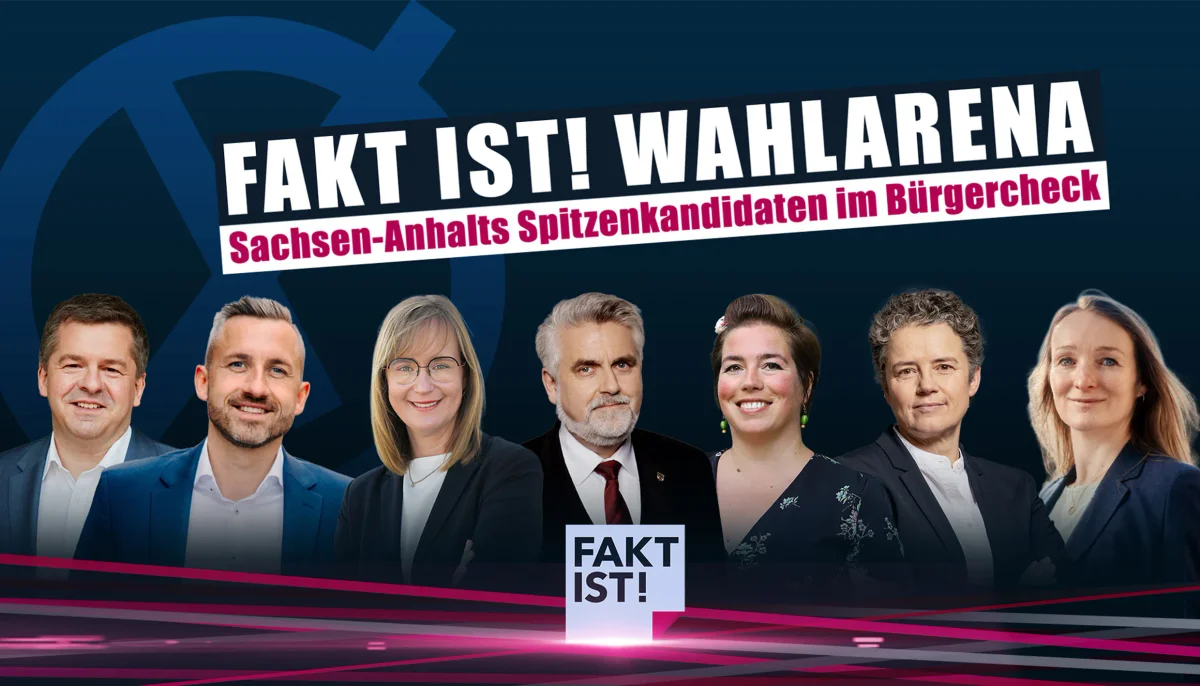
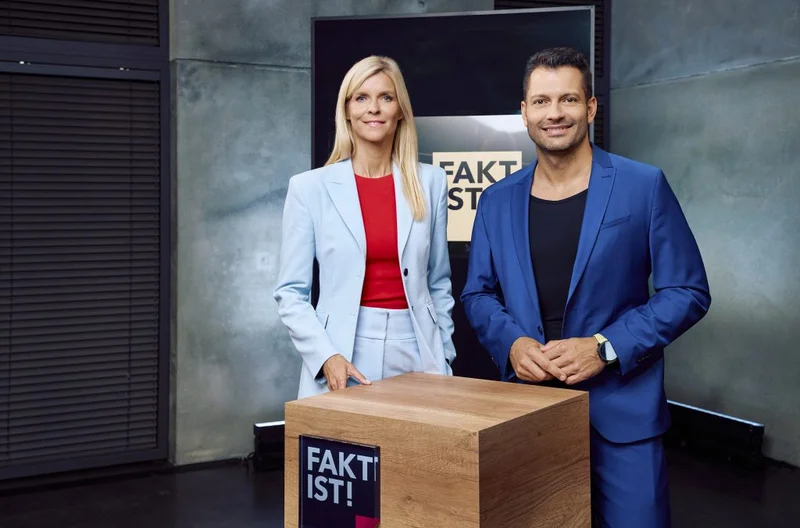
As the Landtag elections in Sachsen-Anhalt approach, the political landscape is heating up. In the MDR program "Fakt ist! Wahlarena," held on August 12, candidates from seven parties faced questions from citizens on pressing issues such as education, inclusion, municipal finances, energy supply, and social cohesion. The event revealed significant contrasts between the questions posed by the public and the often evasive responses provided by the politicians. A fact-check conducted by MDR further highlighted that not all claims made during the debate stood up to scrutiny.
Candidates from Seven Parties
The upcoming election on September 6, 2026, will see candidates from the following parties:
- Sven Schulze, CDU
- Ulrich Siegmund, AfD
- Eva von Angern, Die Linke
- Armin Willingmann, SPD
- Susan Sziborra-Seidlitz, Bündnis 90/Die Grünen
- Lydia Hüskens, FDP
- Claudia Wittig, BSW
Unlike traditional televised debates, this format allowed questions primarily from the audience, bringing real-life issues to the forefront. However, this did not always lead to equally concrete answers. The "Spiegel" encapsulated the evening's sentiment with the headline: "Real citizens ask real questions – and the politicians evade."
The Meaning of "Thinking German"
One particularly striking moment arose when a woman working in a facility for people with disabilities asked AfD candidate Ulrich Siegmund about the implications of the phrase "Deutsch denken" (Thinking German) in relation to education policy. She also questioned why the AfD proposed removing rainbow flags from schools.
Siegmund's response focused on addressing the "root causes" of why people might not feel proud of Germany anymore, failing to connect his answer back to the specific questions about education and rainbow flags.
In contrast, Susan Sziborra-Seidlitz, the Green candidate, asserted, "I am proud of this country." She emphasized that diversity and national identity are not mutually exclusive.
This exchange highlighted a central conflict of the campaign: Is national identity strengthened through exclusion, or does it inherently include diversity and belonging?
AfD's Claims on Direct Democracy
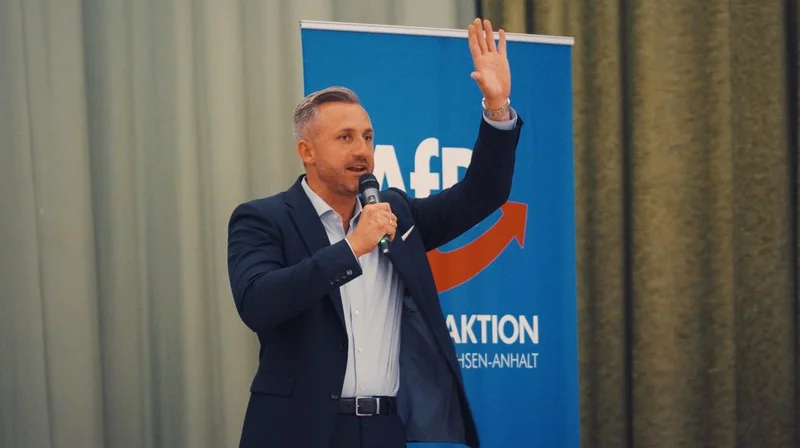
During the broadcast, a fact-check by MDR scrutinized various claims made by the politicians. One assertion by Ulrich Siegmund was that the AfD was the only party advocating for referendums in its program. This claim was found to be inaccurate, as the Greens, Left, SPD, and BSW also support direct democracy and lower thresholds for citizen initiatives.
The specifics of their programs differ, but the fundamental call for increased citizen participation is not unique to the AfD.
Police Protection for Political Events
Siegmund also claimed that every AfD event required police protection, whereas other events did not. The MDR fact-check countered this by citing Christopher Street Day events in Sachsen-Anhalt, which have also seen increased police presence due to threats and assaults. While it is true that AfD members and events face attacks, the implication that other political or social events do not require similar protection was deemed misleading.
Migration Thoughts Among Germans
Not all of Siegmund's assertions were debunked. He stated that about one in five Germans considers emigrating, a claim that can be substantiated. According to a study by the German Centre for Integration and Migration Research, approximately 21% of individuals in Germany are open to the idea of leaving the country. However, it is essential to note that this willingness does not equate to concrete plans for emigration.
School Attendance Requirement in Germany
Siegmund characterized Germany's mandatory school attendance as nearly unique internationally. While it is true that Germany differs from many European nations in prohibiting homeschooling, other countries also enforce similar attendance requirements.
The AfD proposes replacing the current school attendance mandate with an educational obligation, allowing parents to choose between traditional schooling and homeschooling, provided that the latter meets specific quality standards. Thus, while Siegmund's statement contained a kernel of truth, it was overly simplified.
Misinterpretation of Family Roles
CDU candidate Sven Schulze accused the AfD of advocating for a return to traditional gender roles, summarized as "women back to the kitchen." While this exact phrase does not appear in the AfD's program, the party does promote a traditional family model that emphasizes a family structure of "father, mother, and as many children as possible." They aim to prioritize traditional roles and evaluate policies based on their impact on birth rates, proposing to replace equality officers with family representatives.
However, the AfD also calls for free daycare and kindergartens starting from the first child. Schulze's statement was therefore a political exaggeration rather than a precise reflection of the program.
Energy Supply Concerns
The discussion also touched on energy supply issues, with audience members expressing concerns about the low levels of gas storage in Germany. According to MDR, current storage levels are indeed below those of previous years, influenced by high market prices and altered economic incentives. However, Energy Minister Armin Willingmann pointed out that additional import options from Norway, Belgium, the Netherlands, and LNG terminals provide a stable supply. The Federal Network Agency currently assesses the energy supply as stable, indicating that lower storage levels do not imply an immediate risk of gas shortages for households or businesses.
All verified statements and contextual analysis can be found in the MDR fact-checking database related to the Wahlarena.
Polling Trends: AfD Ahead of CDU
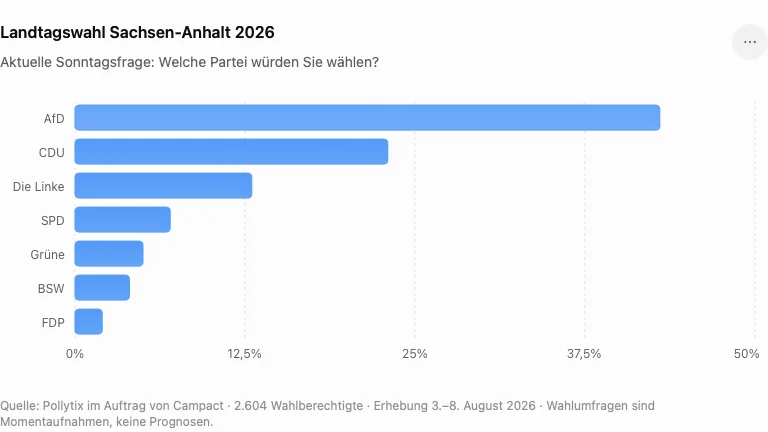
The political significance of the evening is underscored by recent polling data. A survey conducted by the Pollytix Institute for the Campact organization shows the AfD leading with 43%, followed by the CDU at 23%, the Left at 13%, the SPD at 7%, the Greens at 5%, the BSW at 4%, and the FDP at 2%.
The survey, conducted from August 3 to 8, 2026, involved 2,604 eligible voters. It is important to consider that Campact is politically active and opposes right-wing extremism.
A separate survey by Infratest dimap for MDR, WDR, "Mitteldeutscher Zeitung," and "Volksstimme" on July 30 showed similar trends: AfD at 41%, CDU at 24%, Left at 13%, SPD at 6%, Greens at 5%, BSW at 4%, and FDP at 3%.
This data indicates that the AfD is significantly ahead of the CDU in various polls but has not achieved an absolute majority. The prospects for smaller parties remain uncertain, as slight shifts around the 5% threshold could significantly alter future majority dynamics.
The Power of Direct Questions
The Wahlarena highlighted the importance of direct questions from citizens who are directly affected by political decisions. Topics such as inclusion, education, municipal finances, and societal acceptance are not mere buzzwords; they shape everyday life.
It was particularly noticeable when politicians used specific inquiries as opportunities to deliver pre-prepared messages. The accompanying fact-check served as a valuable tool, not replacing political assessment but revealing where facts were distorted, oversimplified, or inaccurately represented.
With several weeks remaining until the Landtag elections, MDR plans to host further debates on August 26, accompanied by additional fact-checking. It remains to be seen whether candidates will provide more concrete responses or if citizens will continue to deliver the clearer insights.
Text sources: MDR: Information on the Landtag elections in Sachsen-Anhalt 2026, accessed August 13, 2026; MDR: The fact-check for the Wahlarena – verified politician statements, published and updated August 12, 2026; Der Spiegel: "Real citizens ask real questions – and the politicians evade," published August 13, 2026; Augsburger Allgemeine: Polls for the 2026 Landtag election in Sachsen-Anhalt, updated August 13, 2026; Welt: AfD reaches 43% in new poll ahead of the Landtag election, regarding the Pollytix survey commissioned by Campact, published August 13, 2026. Image source: MDR, Hagen Wolf