
Participation in the 108th InfoDVag Lw
An account of participation in the 108th InfoDVag Lw, detailing the journey, experiences, and insights gained during this significant event.
Participation in the 108th InfoDVag Lw
In contemplating how to introduce this article, I found myself torn between leaving readers in suspense regarding the title and providing an immediate explanation of the abbreviation. I opted for clarity: "108. InfoDVag Lw" stands for "108th Official Event for Information for Civil Leaders of the Air Force." While the name might not be immediately illuminating, it is essential to understand its significance. The Bundeswehr defines this event as serving to inform high-ranking civilian leaders from business, public service, science, and other notable public figures about the Bundeswehr’s security and defense policies, aiming to foster support through these key intermediaries. This event represents a unique form of official gatherings within the context of the Bundeswehr's reservist activities.
So, how does one participate in such an event? Last year, I joined the Reservists Association, which, due to legal reasons, initially limited my participation in military training events. I was eager to support the Bundeswehr, particularly in the IT sector, and learned about the InfoDVags, which are typically held twice a year by each branch of the armed forces, with a limited number of participants. I decided to apply for the Air Force event, which lasts nearly two weeks, compared to about a week for the Army or Navy. After filling out the application form and submitting it to the Air Force Command, I awaited a response, half-expecting a rejection due to the limited slots available. Instead, I quickly received an email with additional information about the 108th and 109th InfoDVags, along with a personnel questionnaire, indicating that I had not yet been denied. After returning the questionnaire, I was informed that I was on the applicant list, although the selection process could take some time as it required approval from high-ranking officials within the Air Force. In November 2019, I received the jubilant news: "We are pleased to inform you that you have been selected as a participant!" Shortly thereafter, I received my first email from the Otto-Lilienthal Barracks in Roth, containing initial details and a questionnaire.
Before It All Begins
What were the next steps? First, I had to undergo the mandatory medical examination. On January 20, 2020, I had an appointment at the Bundeswehr Career Center in Nuremberg. Given the stories I had heard about this process, I had been quite anxious, but it turned out to be straightforward. A brief check of my vital functions and values confirmed that I had performed well on the vision and hearing tests.
Monday, March 2
The journey began similarly to the medical examination: I took the ICE train from Aschaffenburg to Nuremberg, but this time I continued to Roth by regional train instead of heading to the Career Center. Upon arrival, Bundeswehr transport vehicles awaited to take us from the station to the barracks. There, all participants gathered in our accommodation building, quickly completing the necessary formalities at the registration desk, where I was assigned to a room labeled "Mr. Pankerl." We then proceeded to the old non-commissioned officer's mess, a beautiful building that unfortunately is no longer in regular use. The official welcome and introduction of the project team and participants took place there, followed by dinner in the UHG facilities, where the day concluded in a friendly atmosphere.
Tuesday, March 3
At 5:45 AM, we gathered for our first morning assembly, the last time in civilian clothing. Afterward, we headed to the troop kitchen for breakfast, which could have rivaled that of a hotel in terms of variety and quality, although the organization revealed it was not just any hotel. The morning was filled with organizational tasks, primarily related to receiving personal equipment, including field uniforms. After a brief return to our room, where the door sign had changed to "Mr. Flieger Pankerl," we had lunch and then took a group photo.
Next, we were welcomed by the commander of the Air Force Training Battalion, who introduced us to the battalion's mission. Following this, we received instruction on military law and soldierly order, including the duties of a military superior and the significance of the oath of allegiance. This led us to the ceremonial oath-taking, a moment that sent chills down my spine as we recited together: "I pledge to serve the Federal Republic of Germany faithfully and to bravely defend the rights and freedoms of the German people!" Immediately after the oath, we were all temporarily promoted to reserve first lieutenant for the duration of the InfoDVag. Receiving the promotion certificate and changing shoulder boards was an exhilarating experience. The day concluded with a buffet in the UHG, and I noticed that the door sign had once again changed, now reading "Mr. First Lieutenant Pankerl." That was the final change.
Wednesday, March 4
 The day began with a morning assembly, this time in field uniforms. It was crucial to set the alarm early, as putting on the field uniform took longer than slipping into civilian clothes. After breakfast, a meticulously planned training day commenced. We started with an introduction to the P8 pistol and G36 rifle, including safety checks and loading techniques. This was followed by exercises on the shooting simulator, where we practiced various drills. After establishing our combat readiness, we headed to the shooting range, where we had field rations for lunch.
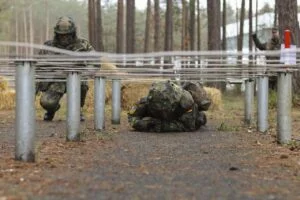
We were divided into groups; some practiced the previously learned exercises with live ammunition, while others engaged in station training focused on navigation and munitions reconnaissance. On the return journey from the shooting range to the barracks, we stopped at the obstacle course, where we received instructions and tackled our first challenges. It became apparent how vital teamwork is among soldiers, as many of us required assistance to overcome the climbing wall. After returning, we attended to equipment maintenance, personal care, and packing for the upcoming journey. Dinner was prepared collaboratively under the motto VENÜ (Demonstrate, Explain, Practice, Exercise), and we ended the evening in the UHG.
Thursday, March 5
The assembly was scheduled for 5:00 AM this time, and breakfast was skipped in favor of lunch packs, which were substantial enough to replace a meal. Luggage was loaded onto a bus, and we headed to Nuremberg Airport, where we entered a large basement area designated as a waiting zone for military flights. Unfortunately, the duty-free shop was closed. From there, we boarded a Belgian military aircraft, which I believe was a Dassault Falcon 900, accommodating about 20 passengers. The flight was arranged through the European Air Transport Command, which facilitates flight services among several countries. During our flight from Nuremberg to Cologne, we had a unique experience as the cockpit door remained open, allowing us to observe the pilots at work. Upon landing in Cologne, we unloaded the aircraft and moved our luggage to a bus for a short ride to the terminal where we collected our bags. Sometimes, the security measures felt excessive.
Next, we traveled to the Air Force Barracks in Cologne, where we were treated to an engaging presentation by the deputy inspector of the Air Force about the command structure. After a communal lunch in the troop kitchen, further briefings were given on the Air Force Troop Command and the reserve section of the Air Force Command.
Finally, we took a bus transfer to the flight readiness unit of the Ministry of Defense, where we received a presentation and toured an A310 configured for medical evacuation and VIP transport for the government. The differences between the two configurations were striking, especially the "Chancellor area" in the government version. Originally, we were supposed to transfer to Kalkar for hotel accommodations, but due to scheduling shifts and traffic delays, we ended up dining in a Turkish restaurant while still in our field uniforms.
Friday, March 6
After spending the night in a hotel, we enjoyed breakfast there before checking out and loading our luggage onto the bus. We then headed to the Center for Air Operations. Following a welcome from the commander, we were presented with the ongoing developments at the site, including the Space Situational Center and the National Airspace Security Command Center. Unfortunately, a planned tour of the command center was canceled due to health concerns regarding a new virus emerging from China, as any illness among staff could necessitate a complete airspace lockdown. After saying our goodbyes, we returned to the nearest troop kitchen for lunch. Later, we traveled to Weeze Airport for our flight back, this time to Laupheim.