The Horse: A Bridge Between Worlds
The horse has traversed human history as a powerful symbol of freedom and strength. This article explores its spiritual significance across cultures, its role as a guide, and its connection to the cycles of life.
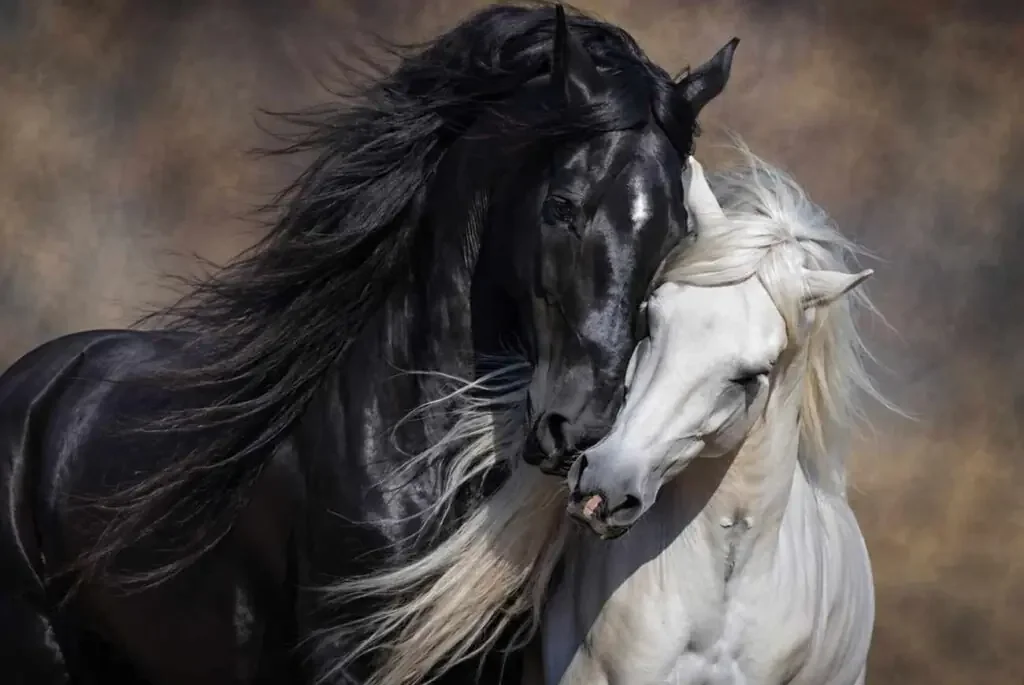
Throughout human history, one animal stands out as a timeless symbol of power and presence: the horse. Revered across various civilizations, the horse has been a companion in wars and a guardian of travelers, embodying freedom and strength.
Beyond its tangible role in our material world, there exists an ethereal horse, invisible to the naked eye, traversing the spiritual paths of existence. In ancient traditions, the horse was not merely a mode of transportation; it was a liminal being, capable of crossing boundaries between the realms of humans and deities, life and death, the seen and the unseen. Thus, when a horse appears in our dreams, during meditation, or as a spirit guide, our souls recognize it as an ancient call.
The horse symbolizes primordial energy, its gallop reminiscent of the wind, its breath echoing the essence of life. Its strength emerges from a harmonious balance between instinct and awareness, encapsulating deep human impulses. This vital energy, when respected, leads to spiritual fulfillment; however, if suppressed or dominated, it can become restless and uncontrollable. For the Celts, the horse represented much more than an animal; it was a manifestation of sovereignty. Possessing the blessing of the horse also meant receiving the blessing of the land. Among the most captivating figures is Epona, the great goddess of horses, protector of travelers, fertility, abundance, and wandering souls. Her worship was so widespread that even the Romans adopted her, a rare occurrence for a Celtic deity.
Epona’s teachings are simple yet profound: true wealth arises when we learn to ride our souls rather than trying to control the world. Wisdom cannot be seized through force; it can only choose to reveal itself to those willing to listen. In shamanic traditions, the horse is also a powerful spiritual animal. The shaman’s drum is often referred to as “the horse of the shaman,” where each beat symbolizes a hoof, each rhythm opens a door, and every journey leads to the spirits. Consequently, it becomes a symbol of ecstatic travel. When the horse appears as a spirit animal, it encourages us to trust in the flow of life, promoting courage, dignity, and presence rather than fleeing.
What guidance does the horse offer as an oracle? In readings, the horse urges us to explore the roots of our restlessness, especially if we struggle to remain still or complete tasks. It prompts self-reflection, reminding us that we may not fully accept the flow of life cycles and our place within them. Connecting with the spirit of the horse allows us to rediscover our purpose and role in the world. This spirit brings energy and speed, linking us to the powers of the earth and the sun. The horse is tied to the complete cycle of birth, death, the afterlife, and rebirth. By working with the horse’s spirit, we can develop a comfort with all aspects of the life cycle, knowing that the horse protects and guides us through each phase.
The horse arrives when it’s time to stop holding our breath, inviting us to reclaim our vital energy, rediscover the rhythm of our hearts, and remember that true freedom is not about binding ties but being faithful to our most authentic nature. Those who engage with the energy of the horse often feel a sense of wholeness, as if every part of their lives begins to move in the same direction. The horse does not drag us along but accompanies us, inviting rather than forcing.
Seeing horses repeatedly—whether through photographs, statues, or in dreams—highlights several themes: the need to regain energy, a call toward a new direction, the necessity of trusting one's intuition, overcoming a prolonged phase of stagnation, reclaiming personal freedom, and the courage to follow a spiritual path. It’s essential to note that no symbol holds a universal and immutable meaning; interpretation always depends on context and the emotions evoked by the encounter. This relationship between the encounter and individual experience makes the oracle so captivating.
The colors of the horse are associated with different symbolic qualities:
The White Horse is perhaps the most potent image, representing the purity of spirit and divine guidance, invisible protection, and contact with the otherworld. In Celtic legends, the white horse accompanies deities and leads to the realms beyond. When it appears in dreams, it is often interpreted as a symbol of spiritual awakening.
The Black Horse does not necessarily signify negative darkness; in initiatory traditions, it represents mystery, the unconscious, and the depths of the soul. The black horse invites us to confront our fears rather than avoid them and is a guardian of profound transformations, symbolizing personal and spiritual power.
The Red Horse evokes the fire of life, embodying passion, courage, instinct, and creative power. It can indicate a moment when personal energy seeks a constructive direction.
The Brown Horse is the keeper of the earth, symbolizing stability, groundedness, and patience. It serves as a reminder that every spiritual growth requires deep roots.
The Gray Horse exists between light and shadow, often associated with the wisdom of elders, ancestors, and reflective times. It symbolizes transitions, thresholds, and significant decisions.
In shamanic traditions, the horse appears to unify all elements, running on the earth, breathing the air, crossing water, and igniting inner fire. This completeness makes it one of the most universal archetypes.
The horse embodies the raw strength of nature that must be purified through awareness; it should not be killed but transformed. Instinct is not the enemy of spirit; it is its ally when illuminated by consciousness. The horse reminds us of a fundamental principle of inner alchemy: one does not become a spiritual being by rejecting their nature; instead, it is honored by learning to ride with balance, respect, and presence.
Every spiritual path must be traveled with courage while heeding the call of one’s soul. For millennia, the horse has continued to remind us of this truth, galloping through myths, cultures, and invisible worlds. It symbolizes strength that does not dominate but supports, freedom that does not flee but chooses, and journeys that lead us away from ourselves to the most sacred place of all: the heart.
It does not ask us to follow it but to discover the authentic rhythm of our own steps, so that one day we may ride through life with the same elegance, confidence, and harmony with which it has always traversed the boundary between earth and sky.